
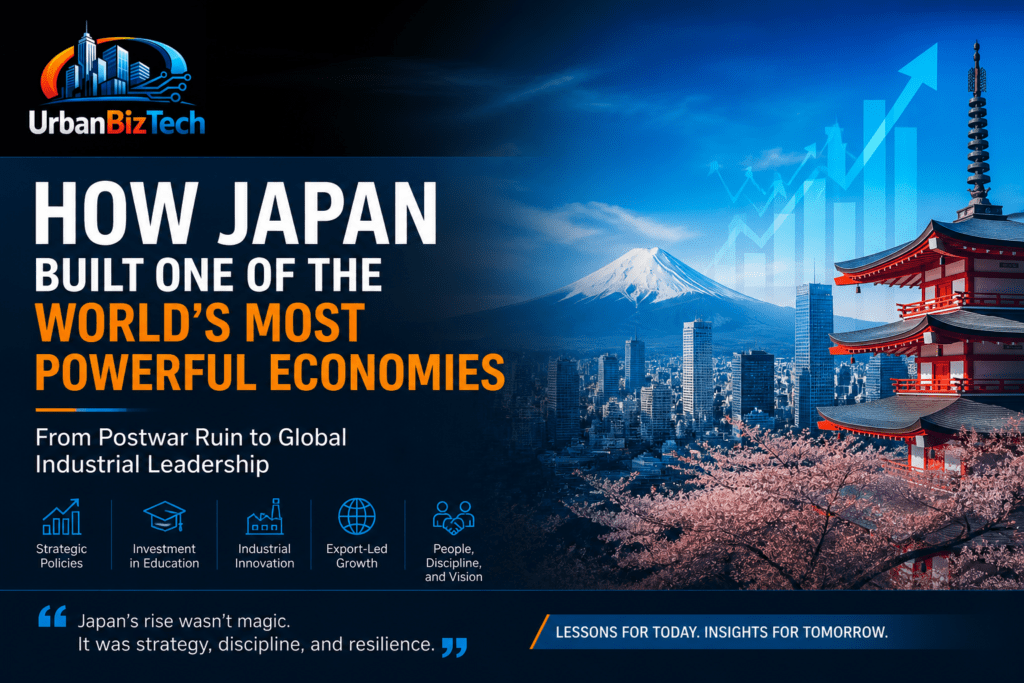
From Postwar Ruin to Global Industrial Leadership
🔥 Why Japan’s Economic Rise Still Matters
Few economic transformations in modern history rival that of Japan. In the aftermath of World War II, the country faced near-total devastation—industrial collapse, widespread poverty, and institutional upheaval.
Yet within a single generation, Japan achieved what many economists now call an “economic miracle”: it became the world’s second-largest economy, a manufacturing powerhouse, and a global leader in technology and innovation.
This transformation was not accidental. It was the result of deliberate policy, institutional coordination, cultural factors, and favorable geopolitical conditions.
So how did Japan do it—and what lessons actually hold up under scrutiny?
🧨 Postwar Collapse and Structural Reset (1945–1952)
In 1945, Japan’s economy was in ruins:
- Industrial output had fallen dramatically
- Urban infrastructure was heavily damaged
- Inflation surged, and food shortages were widespread
- Millions were unemployed
Under the occupation led by United States, Japan underwent sweeping reforms:
- A new constitution established democratic governance
- Land reforms redistributed wealth and boosted rural productivity
- Large industrial conglomerates were partially dismantled
- Labor rights were expanded
- Education was modernized
These reforms laid the institutional foundation for long-term growth—especially by promoting competition, human capital, and political stability.
🏗️ The Rise of the Developmental State (1950s–1960s)
Japan did not follow a purely free-market model. Instead, it developed a coordinated system often described as a “developmental state.”
At the center of this system was MITI, which played a strategic role in:
- Identifying priority industries
- Guiding capital allocation
- Protecting emerging sectors
- Promoting exports
Rather than controlling the economy outright, the government worked closely with private firms—creating a hybrid model of state guidance and market competition.
🎓 Human Capital: Japan’s Most Valuable Resource
Contrary to popular narratives, Japan’s greatest asset was never natural resources—it was its people.
Key investments included:
- Universal education with strong emphasis on science and engineering
- Corporate training systems that continuously upgraded worker skills
- A culture that valued precision, discipline, and collective success
This produced a highly skilled workforce capable of absorbing and improving foreign technologies.
🏢 Industrial Networks: The Keiretsu System
Postwar Japan saw the emergence of tightly connected corporate groups known as keiretsu, including firms like:
- Toyota
- Sony
- Mitsubishi
These networks were characterized by:
- Cross-shareholding
- Long-term banking relationships
- Supply chain integration
This structure enabled stability, long-term planning, and resilience during economic shocks.
🚀: The Economic Miracle (1955–1973)
Between the mid-1950s and early 1970s, Japan experienced one of the fastest growth periods in economic history:
- Average GDP growth approached 10% annually
- Industrial output surged
- Living standards improved dramatically
A critical but often overlooked factor was the Korean War, which generated massive procurement demand from U.S. forces—effectively jumpstarting Japan’s.
Export-Led Growth
Japan adopted a clear strategy:
- Produce high-quality goods
- Maintain competitive pricing
- Target global markets
This approach transformed Japan into a leading exporter of:
- Automobiles
- Consumer electronics
- Industrial machinery
⚡ Energy Shock and Strategic Adaptation (1970s–1980s)
The 1973 Oil Crisis posed a serious threat to Japan, which relied heavily on imported energy.
Instead of stagnating, Japan adapted by:
- Investing in energy-efficient technologies
- Shifting toward high-value, low-energy industries
- Advancing semiconductor and electronics production
By the 1980s, Japan had become a global leader in advanced manufacturing and technology.
💥 The Asset Bubble and Lost Decade (1990s)
Rapid growth eventually led to excess.
During the late 1980s:
- Real estate prices soared
- Stock markets became inflated
- Credit expanded aggressively
The bubble burst in the early 1990s, triggering:
- Financial instability
- Prolonged economic stagnation
- Deflationary pressures
This period—often called the “Lost Decade”—highlighted structural weaknesses in Japan’s financial system.
🧠 Japan in the 21st Century: Resilient but Challenged
Today, Japan remains one of the world’s largest economies, but faces structural challenges:
Key Challenges
- Aging population
- Low birth rates
- High public debt
- Sluggish domestic demand
Enduring Strengths
- Advanced infrastructure
- Leadership in robotics and precision manufacturing
- Strong export sectors
- High levels of technological expertise
🧩 Why Japan Succeeded: The Real Drivers
Japan’s rise cannot be reduced to a single factor. Its success was built on a combination of:
- Strategic state guidance
- Private-sector dynamism
- Investment in education and skills
- Export-oriented industrialization
- Institutional stability
- Long-term planning
Equally important, Japan benefited from its geopolitical position during the Cold War, which provided security and access to global markets.
🌍 What Can Other Countries Learn?
Japan’s experience offers valuable insights—but not a simple blueprint.
Transferable Lessons
- Prioritize education and human capital
- Support competitive domestic industries
- Align government policy with long-term economic goals
- Encourage innovation and technological upgrading
What Doesn’t Transfer Easily
- Cultural norms around work and organization
- Historical timing and geopolitical advantages
- Institutional continuity
Economic transformation is always context-dependent.
🧠 Final Takeaway
Japan did not rise because of natural wealth—it rose despite the lack of it.
Its true resources were:
- Human capital
- Institutional discipline
- Strategic coordination
- Relentless focus on quality and innovation
The “Japanese miracle” is not a myth—but it is often misunderstood. It was not magic. It was policy, pressure, adaptation, and persistence over decades.
❓ Frequently Asked Questions (FAQ)
1. How did Japan rebuild its economy after World War II?
Japan rebuilt its economy through a combination of structural reforms, strong government guidance, and investment in human capital. Support from United States during the postwar occupation, along with industrial policy led by MITI, played a crucial role in stabilizing and modernizing the economy.
2. What is the “Japanese economic miracle”?
The “Japanese economic miracle” refers to the period between the 1950s and early 1970s when Japan experienced rapid economic growth—averaging around 10% annually—transforming it into the world’s second-largest economy.
3. Did Japan succeed without natural resources?
Not entirely. While Japan lacks major reserves of oil and minerals, its true strength lies in its highly educated workforce, technological innovation, and efficient industrial systems.
4. What role did exports play in Japan’s growth?
Exports were central to Japan’s strategy. By producing high-quality, competitively priced goods, companies like Toyota and Sony successfully expanded into global markets.
5. How did the Korean War impact Japan’s economy?
The Korean War created significant demand for Japanese goods and services from U.S. military forces, providing an early economic boost that accelerated industrial recovery.
6. What caused Japan’s economic stagnation in the 1990s?
Japan’s stagnation was mainly due to the collapse of an asset bubble in real estate and stock markets. This led to a prolonged period of low growth, deflation, and financial instability known as the “Lost Decade.”
7. What are Japan’s biggest economic challenges today?
Modern challenges include:
- An aging population
- Declining birth rates
- High public debt
- Slower domestic consumption
8. What lessons can other countries learn from Japan?
Countries can learn the importance of:
- Investing in education and skills
- Supporting strategic industries
- Encouraging innovation
- Maintaining long-term economic planning
However, Japan’s success is context-specific and cannot be copied exactly.
9. Is Japan still a major global economic power?
Yes. Despite challenges, Japan remains the world’s third-largest economy and a global leader in advanced manufacturing, robotics, and technology.
Pingback: Why Germany Is the Largest Economy in Europe