
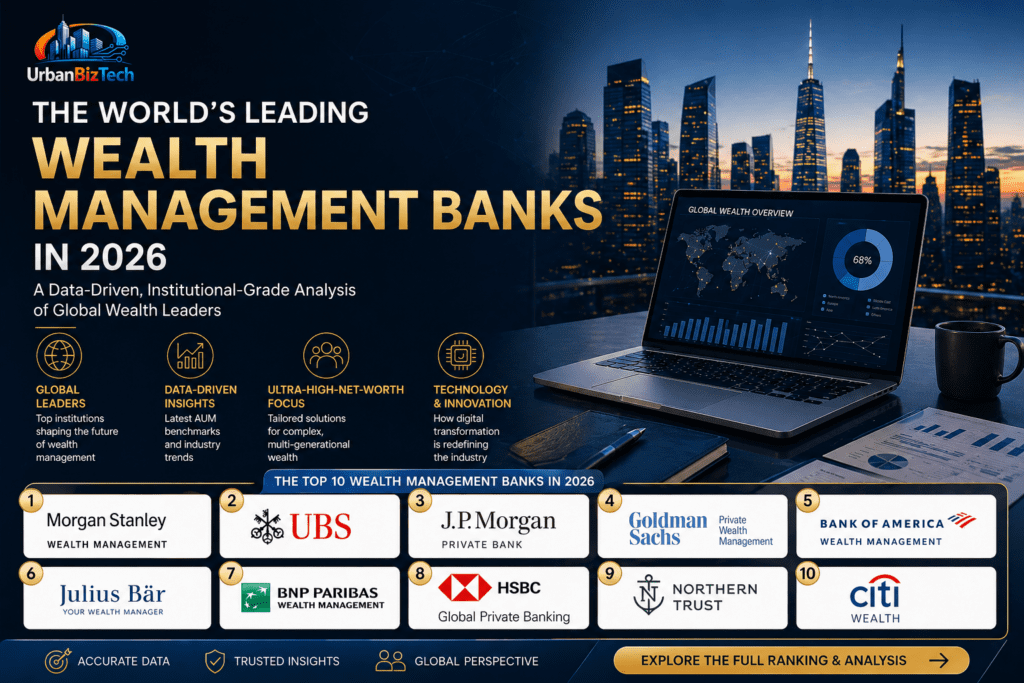
A Data-Driven, Institutional-Grade Analysis of Global Wealth Leaders
Wealth management has evolved into one of the most sophisticated segments of global finance, driven by rising ultra-high-net-worth (UHNW) populations, cross-border capital flows, and rapid digital transformation. Today’s top wealth management institutions distinguish themselves not only by assets under management (AUM), but also by advisory depth, global reach, technological infrastructure, and ability to serve complex, multi-generational wealth needs.
This report presents a refined and professionally validated ranking of the world’s most influential wealth management banks as of 2025–2026, correcting common misconceptions and applying a more comprehensive evaluation framework.
Methodology: What Defines a Top Wealth Manager?
Rather than relying solely on AUM, this ranking considers:
- Assets Under Management (Wealth Segment Only)
- Client Focus (HNW vs. UHNW)
- Global Footprint
- Advisory Capabilities (tax, estate, philanthropy)
- Investment Platform Strength
- Digital & Technological Innovation
Top Global Wealth Management Institutions
1. Morgan Stanley Wealth Management

Estimated AUM: ~$5–6 trillion (wealth segment)
Morgan Stanley remains the global leader in wealth management, largely due to its unmatched scale and integration of advisory services with institutional-grade investment capabilities. Its acquisition of E*TRADE and Eaton Vance significantly strengthened both its digital and asset management ecosystem.
Key Strengths:
- Industry-leading advisor network
- Strong hybrid model (digital + human advisory)
- Dominance in the U.S. high-net-worth segment
2. UBS Global Wealth Management

Estimated AUM: ~$4–5 trillion
UBS is widely regarded as the world’s premier wealth manager for ultra-high-net-worth clients. Following its acquisition of Credit Suisse, it further solidified its dominance in global private banking.
Key Strengths:
- Deep expertise in UHNW advisory
- Strong presence in Europe, Asia, and emerging markets
- Renowned Swiss private banking heritage
3. J.P. Morgan Private Bank

Estimated AUM: ~$2–3 trillion
J.P. Morgan Private Bank combines elite advisory services with one of the strongest research and investment platforms globally, making it a preferred partner for billionaires, family offices, and institutional clients.
Key Strengths:
- Best-in-class research and macro insights
- Strong alternative investment platform
- Integrated global banking ecosystem
4. Goldman Sachs Private Wealth Management

Estimated AUM: ~$1–2 trillion
Goldman Sachs focuses almost exclusively on ultra-wealthy individuals, offering highly customized investment strategies and access to exclusive opportunities.
Key Strengths:
- Elite client base (UHNW)
- Advanced alternative investments
- Strong risk management expertise
5. Bank of America Global Wealth & Investment Management (Merrill + Private Bank)

Estimated AUM: ~$3–4 trillion
Through Merrill and its Private Bank, Bank of America offers one of the most comprehensive wealth platforms globally, combining scale with accessibility.
Key Strengths:
- Broad client coverage (mass affluent to UHNW)
- Strong U.S. dominance
- Integrated banking and lending solutions
6. Julius Baer Group

Estimated AUM: ~$500–700 billion
A pure-play wealth manager, Julius Baer focuses exclusively on private banking, offering highly personalized services with a strong emphasis on discretion and long-term relationships.
Key Strengths:
- Pure wealth management focus
- Strong reputation in Europe and Asia
- High-touch advisory model
7. BNP Paribas Wealth Management

Estimated AUM: ~$500–600 billion
BNP Paribas stands as Europe’s leading wealth manager, with deep expertise in cross-border advisory and strong positioning in both European and Asian markets.
Key Strengths:
- European market leadership
- Strong regulatory and tax advisory
- Growing Asian presence
8. HSBC Global Private Banking

Estimated AUM: ~$400–600 billion
HSBC leverages its global network—especially in Asia and the Middle East—to serve internationally mobile wealthy clients.
Key Strengths:
- Cross-border expertise
- Dominance in Asia
- Strong international banking integration
9. Northern Trust Wealth Management

Estimated AUM: ~$1 trillion+ (including custody-related assets)
Northern Trust is a leader in servicing family offices and institutional wealth, particularly known for its trust, custody, and fiduciary capabilities.
Key Strengths:
- Family office specialization
- Institutional-grade infrastructure
- Strong fiduciary reputation
10. Citigroup Wealth (Citibank)

Estimated AUM: ~$1 trillion
Citi Wealth benefits from a vast global network, making it a strong choice for internationally diversified clients and entrepreneurs.
Key Strengths:
- Global reach across 90+ markets
- Strong emerging markets presence
- Cross-border investment solutions
Key Industry Trends in 2026
1. Rise of Ultra-High-Net-Worth Clients
The fastest-growing segment is individuals with over $30 million in assets, driving demand for bespoke advisory services.
2. Consolidation of Swiss Banking
The integration of Credit Suisse into UBS has reshaped the competitive landscape, reinforcing UBS’s dominance.
3. Technology as a Differentiator
Firms are investing heavily in:
- AI-driven portfolio management
- Digital client platforms
- Data-driven personalization
4. Expansion in Asia and the Middle East
These regions are now the primary growth engines for global wealth management.
Final Analysis
The global wealth management industry is no longer defined purely by size. While firms like Morgan Stanley and UBS dominate in scale, true leadership now depends on a combination of:
- Personalized advisory
- Global connectivity
- Technological innovation
- Access to exclusive investment opportunities
In this increasingly competitive landscape, the institutions that succeed are those that seamlessly integrate human expertise with advanced technology—while maintaining trust across generations of wealth.
Frequently Asked Questions (FAQ)
What is wealth management?
Wealth management is a comprehensive financial service that combines investment management, financial planning, tax optimization, estate planning, and advisory services to help individuals grow and protect their wealth over time.
What is the difference between wealth management and private banking?
While the terms are often used interchangeably, there are key differences:
- Wealth Management: Focuses on investment strategies and long-term financial planning.
- Private Banking: Includes wealth management but also offers banking services like lending, deposits, and credit solutions.
Institutions like J.P. Morgan and UBS provide both under integrated platforms.
Which bank is the largest wealth manager in the world?
Currently, Morgan Stanley is widely considered the largest wealth manager globally by assets under management in its wealth division, followed closely by UBS.
What does AUM (Assets Under Management) mean?
AUM refers to the total market value of assets that a financial institution manages on behalf of its clients. It is one of the most important indicators of scale and influence in wealth management.
Who are the typical clients of wealth management banks?
Wealth management services are typically designed for:
- High-Net-Worth Individuals (HNWIs)
- Ultra-High-Net-Worth Individuals (UHNWIs)
- Family offices
- Entrepreneurs and business owners
Banks like Goldman Sachs specialize heavily in ultra-wealthy clients.
What services do top wealth management banks offer?
Top institutions provide a wide range of services, including:
- Portfolio and investment management
- Tax and estate planning
- Philanthropy advisory
- Risk management
- Alternative investments (private equity, hedge funds)
Firms such as Bank of America and HSBC offer highly integrated solutions.
Are wealth management services only for the ultra-rich?
Not necessarily. While many services target UHNW clients, some banks—like Citigroup—offer solutions for mass affluent and emerging wealthy clients as well.
What trends are shaping wealth management in 2026?
Key trends include:
- Rise of AI-driven investment strategies
- Growth of family offices
- Increased demand for ESG (sustainable investing)
- Expansion in Asia and the Middle East
Institutions like BNP Paribas and Northern Trust are actively investing in these areas.
How do I choose the right wealth management bank?
You should consider:
- Your net worth and financial complexity
- Geographic needs
- Access to exclusive investments
- Advisory quality and reputation
For example, Julius Baer is known for highly personalized services, while Morgan Stanley offers scale and technology.
Is wealth management worth it?
For individuals with significant assets, professional wealth management can:
- Improve long-term returns
- Reduce risk
- Optimize taxes
- Ensure smooth wealth transfer across generations
Pingback: Best Swiss Banks for Wealth Management (2026 Guide): Top Private Banks for Family Offices and UHNW Investors
Pingback: Best Private Banks & Wealth Management Firms in the U.S.
Pingback: Top Private Banks for Wealth Management and Family Offices: Best Private Banks for Wealth Management and Family Offices (2026 Guide)