
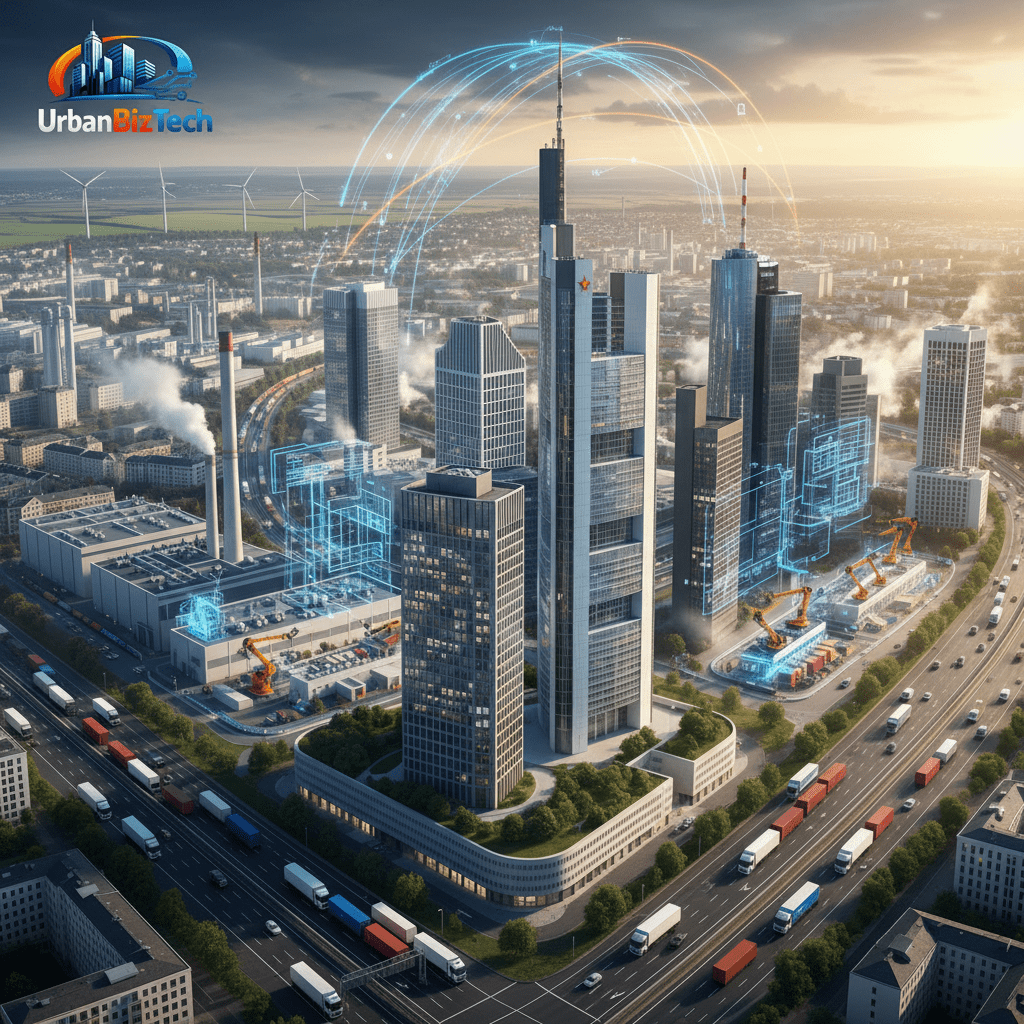
In the shifting architecture of the global economy, few countries demonstrate structural resilience quite like Germany.
By 2024–2025, Germany had become the third-largest economy in the world by nominal GDP, surpassing Japan according to estimates from the International Monetary Fund. With an economy valued at roughly $5 trillion, Germany remains the industrial and financial backbone of Europe.
But Germany’s economic strength is not accidental. It is the result of decades of institutional design, industrial specialization, export dominance, and technological investment.
This article explores the deeper structural forces behind Germany’s economic power.
1. The Historical Foundations of German Economic Power
The Post-War Economic Miracle
After the devastation of World War II, West Germany experienced one of the most remarkable recoveries in economic history: the Wirtschaftswunder (economic miracle).
Key drivers included:
- Currency reform in 1948
- Market liberalization policies
- Industrial reconstruction
- Integration into Western trade networks
Economics minister Ludwig Erhard championed the concept of the social market economy, blending free markets with social stability.
This model created a uniquely German balance between capitalism and social welfare that still shapes policy today.
2. German Reunification: A Shock That Became a Long-Term Asset
The reunification of East and West Germany in 1990 initially posed enormous economic costs.
Massive investments were required to modernize the eastern regions. Over time, however, reunification:
- Expanded Germany’s domestic market
- Increased labor supply
- Strengthened infrastructure networks
- Positioned Germany at the geographic center of Europe
Today, a unified Germany anchors the economic structure of the European Union.
3. The Industrial Core: Why Germany Still Manufactures
Unlike many advanced economies that shifted heavily toward services, Germany preserved a powerful industrial base.
Manufacturing accounts for roughly a quarter of economic output, far higher than in countries like the United States or the United Kingdom.
Major sectors include:
- Automotive engineering
- Industrial machinery
- Chemicals and pharmaceuticals
- Precision manufacturing
- renewable energy technologies
Global industrial leaders such as:
- Volkswagen
- BMW
- Mercedes-Benz Group
- Siemens
- BASF
form the backbone of German exports and technological innovation.
Germany’s competitive advantage lies not in low costs, but in high-value engineering.
4. The Mittelstand: The Hidden Engine of the German Economy
Perhaps the most underestimated force behind Germany’s success is the Mittelstand.
These are typically:
- family-owned firms
- highly specialized manufacturers
- export-oriented
- long-term focused
Many of them are “hidden champions” — global market leaders in narrow industrial niches.
Examples include companies producing:
- precision sensors
- industrial robotics components
- specialized machine tools
Together they employ millions and stabilize the German economy during downturns.
5. Export Powerhouse: Germany’s Global Trade Machine
Germany consistently ranks among the largest exporters in the world.
Key characteristics of German exports:
- High technological content
- Strong global reputation
- Long product life cycles
- Deep integration into global supply chains
The country benefits from its central position within Europe, enabling efficient logistics across the continent.
Germany alone accounts for roughly a quarter of the European Union’s economic output, making it the bloc’s primary economic engine.
6. Education, Skills, and Industrial Intelligence
Germany’s workforce is among the most skilled in the world.
A key factor is the dual education system, combining:
- classroom instruction
- apprenticeships inside companies
This system aligns labor skills directly with industrial needs.
German universities and research institutes also play a critical role, including organizations such as:
- Max Planck Society
- Fraunhofer Society
These institutions drive innovation in fields ranging from advanced materials to artificial intelligence.
7. Fiscal Discipline and Financial Credibility
Germany’s economic credibility is strongly linked to fiscal conservatism.
For decades, policymakers pursued:
- balanced budgets
- controlled inflation
- strong industrial investment
The country also hosts Europe’s financial capital, Frankfurt, home to the European Central Bank.
This financial infrastructure reinforces Germany’s influence over European economic policy.
8. The Energy Shock and Structural Transformation
Germany’s economic model faced a serious test after Russia’s invasion of Ukraine.
For years, German industry relied heavily on energy imports from Russia.
The disruption forced a rapid transformation in energy policy.
The country accelerated investment in:
- renewables
- LNG infrastructure
- green hydrogen
- industrial decarbonization
This transition may redefine German competitiveness over the next decade.
9. Why Germany Overtook Japan
Germany surpassed Japan largely due to:
- Exchange-rate effects weakening the yen
- Germany’s export resilience
- demographic stagnation in Japan
- stronger industrial pricing power
Even so, the competition between the two economies remains close and could shift again in the future.
10. The Structural Challenges Ahead
Despite its strength, Germany faces significant long-term challenges:
Demographics
An aging population may reduce the workforce.
Energy Costs
Industrial electricity prices remain higher than in competing economies.
Global Competition
Rising technological competition from China and the United States.
Industrial Transformation
The shift to electric vehicles and green manufacturing could reshape entire sectors.
Germany’s Economic Model in a Changing World
Germany’s rise to become Europe’s largest economy and one of the world’s top three reflects a rare combination of:
- industrial depth
- institutional stability
- technological specialization
- export excellence
Yet the coming decade may test the German model more than any period since reunification.
If Germany successfully navigates energy transition, demographic change, and technological competition, it may remain one of the central pillars of the global economy for decades to come.
Frequently Asked Questions (FAQ)
Why is Germany the largest economy in Europe?
Germany has the largest economy in Europe due to its powerful industrial base, strong export sector, advanced engineering industries, and highly skilled workforce. The country also benefits from stable institutions and deep integration within the European Union.
Is Germany really the third-largest economy in the world?
Yes. According to estimates from the International Monetary Fund in 2024–2025, Germany surpassed Japan in nominal GDP, becoming the world’s third-largest economy after the United States and China. Exchange rates played a role in this ranking.
What industries drive the German economy?
Germany’s economy is driven by high-value manufacturing sectors such as:
- Automotive production
- Industrial machinery
- Chemicals and pharmaceuticals
- Electrical engineering
Major companies include Volkswagen, BMW, Mercedes-Benz Group, and Siemens.
What is the Mittelstand and why is it important?
The Mittelstand refers to thousands of small and medium-sized German companies that are often family-owned and export-oriented. Many are global leaders in niche industrial markets and form the backbone of Germany’s economy.
Why is Germany such a strong exporting country?
German products are known worldwide for their quality, durability, and engineering excellence. Germany’s central location in Europe also allows efficient logistics and supply chains across the continent.
What challenges does Germany’s economy face?
Despite its strength, Germany faces several challenges:
- Aging population
- High energy costs
- Global competition from the China and the United States
- Industrial transition toward green technologies
How important is innovation to Germany’s economy?
Innovation is central to Germany’s economic model. Research institutions like the Max Planck Society and the Fraunhofer Society support technological breakthroughs that keep German industries competitive globally.
Pingback: Why the U.S. Dollar Dominates the World Economy
Pingback: Morocco’s Industrial Rise: How It Became North Africa’s Leading Manufacturing Hub
Pingback: How Japan Built a Global Economic Powerhouse After World War II