
United Arab Emirates
From Resource Dependency to Strategic Reinvention
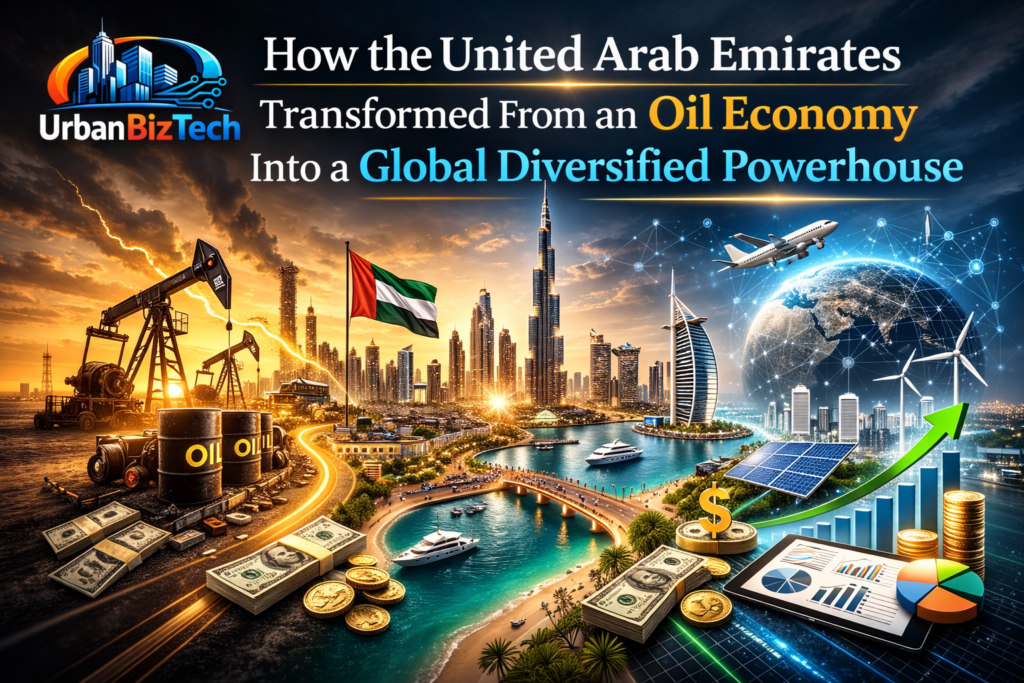
In just five decades, the United Arab Emirates has engineered one of the most ambitious economic transformations in modern history.
At the time of its formation in 1971, oil accounted for more than 90% of GDP. Hydrocarbon revenues financed infrastructure, education, healthcare, and state-building. But Emirati leadership understood a critical truth early: oil is finite, volatility is inevitable, and long-term prosperity requires structural diversification.
Today, non-oil sectors contribute roughly 70–75% of the UAE’s GDP—an extraordinary shift in a region traditionally dependent on hydrocarbons.
This is not merely diversification. It is strategic reinvention.
Phase One: Oil as a Launchpad, Not a Destination
Oil wealth was never treated as an endpoint. Instead, it became investment capital.
Energy revenues funded:
- World-class infrastructure
- Ports and aviation hubs
- Education systems
- Sovereign investment vehicles
- Industrial capacity
Rather than distributing oil income passively, the UAE reinvested aggressively into long-term economic multipliers.
Strategic Vision: The Policy Architecture Behind the Transformation
The UAE’s diversification was not accidental—it was policy-driven.
🇦🇪 Vision 2021
Focused on building a competitive, knowledge-based economy.
🇦🇪 UAE Centennial 2071
A long-term blueprint to position the country among the world’s leading economies through innovation, education, and sustainability.
Liberalized Business Environment
- 100% foreign ownership in many sectors
- Zero personal income tax
- Competitive corporate tax framework
- Extensive free zones
This regulatory flexibility became a magnet for global capital.
The Non-Oil Sectors Powering the UAE’s Rise
1. Tourism: From Desert Landscape to Global Destination
Dubai and Abu Dhabi transformed into global tourism brands.
Landmarks such as:
- Burj Khalifa
- Palm Jumeirah
- Expo 2020 Dubai
positioned the UAE as a luxury, business, and events hub.
Tourism contributes approximately 11–12% of GDP, supported by world-class hospitality infrastructure and aviation connectivity.
2. Aviation: A Global Transit Superpower
Geography became strategy.
Carriers like:
- Emirates
- Etihad Airways
turned the country into a bridge between Europe, Asia, and Africa.
Dubai International Airport consistently ranks among the busiest global airports for international passengers.
Aviation not only fuels tourism but also strengthens logistics, trade, and high-value services.
3. Financial Services: The Region’s Capital Gateway
The UAE positioned itself as a financial hub through internationally structured zones such as:
- Dubai International Financial Centre
- Abu Dhabi Global Market
These jurisdictions operate under independent legal frameworks aligned with international standards, attracting banks, hedge funds, fintech firms, and multinational corporations.
4. Technology and the Digital Economy
The UAE was among the first nations to appoint a Minister of Artificial Intelligence.
The country has invested heavily in:
- AI research
- Smart cities
- Blockchain infrastructure
- Startup ecosystems
- Digital government
Dubai aims to be one of the world’s most digitally integrated cities, leveraging innovation as an economic growth engine rather than a secondary sector.
5. Renewable Energy: Preparing for a Post-Oil Future
While still a hydrocarbon producer, the UAE is investing aggressively in clean energy.
Key initiatives include:
- Masdar City
- Mohammed bin Rashid Al Maktoum Solar Park
- Hosting the headquarters of International Renewable Energy Agency
The country is positioning itself as both an energy exporter and a renewable energy innovator.
6. Advanced Industry and Manufacturing
Beyond services, the UAE developed:
- Aerospace components
- Aluminum production
- Petrochemicals
- Defense manufacturing
- Food security infrastructure
Industrial policy is increasingly focused on high-value manufacturing rather than commodity output.
The Role of Free Zones in Attracting Global Capital
More than 40 free zones operate across the UAE, offering:
- 100% foreign ownership
- Full profit repatriation
- Customs exemptions
- Streamlined licensing
Areas like Jebel Ali Free Zone and Dubai Internet City became sector-specific ecosystems that accelerated cluster development.
This model created a platform economy rather than a traditional oil-export system.
Economic Outcomes: Structural Resilience
The results are measurable:
- Non-oil GDP dominance
- High per capita income
- Regional leadership in FDI inflows
- Global trade hub status
- Stable currency regime
The UAE has demonstrated resilience during oil price shocks, the 2008 financial crisis, and the COVID-19 pandemic.
Diversification provided shock absorption.
Challenges Ahead
No transformation is without risk:
- Exposure to global trade cycles
- Regional competition (notably Saudi Arabia’s Vision 2030 reforms)
- Geopolitical volatility
- Transition risks in global energy markets
Yet the country’s agility and capital reserves offer strategic buffers.
A Global Blueprint for Diversification
The UAE experience provides a case study for resource-rich nations seeking sustainable growth.
The formula appears clear:
- Monetize natural resources
- Reinvest into infrastructure and human capital
- Build regulatory flexibility
- Attract global capital
- Pivot early toward innovation
The UAE did not wait for oil decline—it diversified at peak production.
That timing may be its greatest strategic advantage.
Reinvention as National Strategy
The transformation of the United Arab Emirates is not simply about reducing oil dependence.
It is about redefining national identity around competitiveness, innovation, and global integration.
In a world facing energy transition and technological disruption, the UAE has positioned itself not as a relic of the oil era—but as a contender in the post-oil global economy.
Few nations have executed such a pivot with comparable speed, scale, and strategic coherence.
And the story is still unfolding.
Frequently Asked Questions (FAQ)
1. How did the United Arab Emirates reduce its dependence on oil?
The United Arab Emirates reduced its reliance on oil through long-term strategic planning, investment in infrastructure, and aggressive diversification into sectors such as tourism, aviation, financial services, renewable energy, and technology. Over the past five decades, non-oil industries have grown to contribute roughly 70–75% of GDP.
2. What percentage of the UAE’s economy still depends on oil?
Oil and gas now account for approximately 25–30% of the UAE’s GDP, a significant decline from over 90% at the time of the country’s formation in 1971. The exact percentage fluctuates depending on global energy prices.
3. What are the main non-oil sectors driving the UAE economy?
The main non-oil sectors include:
- Tourism and hospitality
- Aviation and logistics
- Financial services
- Real estate and construction
- Technology and digital economy
- Renewable energy
- Advanced manufacturing
Major hubs such as Dubai International Financial Centre and Abu Dhabi Global Market have strengthened the country’s financial ecosystem.
4. Why is Dubai considered a global economic hub?
Dubai became a global hub due to its strategic geographic location between Europe, Asia, and Africa, pro-business regulations, world-class infrastructure, and global connectivity through airlines like Emirates. Landmark developments such as Burj Khalifa and global events like Expo 2020 Dubai also boosted its international profile.
5. How important is tourism to the UAE economy?
Tourism contributes around 11–12% of the UAE’s GDP. The country attracts millions of international visitors annually through luxury hospitality, business events, retail tourism, and cultural attractions.
6. What role do free zones play in economic diversification?
Free zones are central to the UAE’s diversification strategy. They allow 100% foreign ownership, full profit repatriation, and streamlined business licensing. These zones have attracted multinational corporations, startups, fintech firms, and logistics operators.
7. Is the UAE investing in renewable energy despite being an oil producer?
Yes. The UAE is investing heavily in renewable energy projects such as Masdar City and hosts the headquarters of International Renewable Energy Agency. The country aims to balance hydrocarbon production with long-term sustainability goals.
8. How does the UAE compare to other Gulf countries in diversification?
Compared to many Gulf economies, the UAE diversified earlier and more aggressively. While other countries in the region are now accelerating reform programs, the UAE built global sectors in aviation, tourism, and finance decades ago.
9. What challenges could affect the UAE’s economic model?
Key challenges include:
- Global economic slowdowns
- Energy transition risks
- Regional competition
- Geopolitical volatility
- Exposure to global trade flows
However, strong capital reserves and regulatory flexibility provide resilience.
10. Can the UAE serve as a model for other oil-dependent nations?
Yes. The UAE is often cited as a case study in strategic diversification. Its approach—reinvesting oil revenues into infrastructure, innovation, and global integration—offers lessons for resource-rich nations seeking sustainable, long-term growth.
Pingback: Abu Dhabi’s Financial Rise: How ADGM and Sovereign Wealth Are Reshaping Global Finance
Pingback: Why Dubai Is the World’s Top Magnet for Millionaires and Global Companies
Pingback: Dubai vs Abu Dhabi: The Battle for the Middle East’s Financial Capital
Pingback: How Qatar Became So Rich: The Economic Strategy Behind Its Massive Wealth