
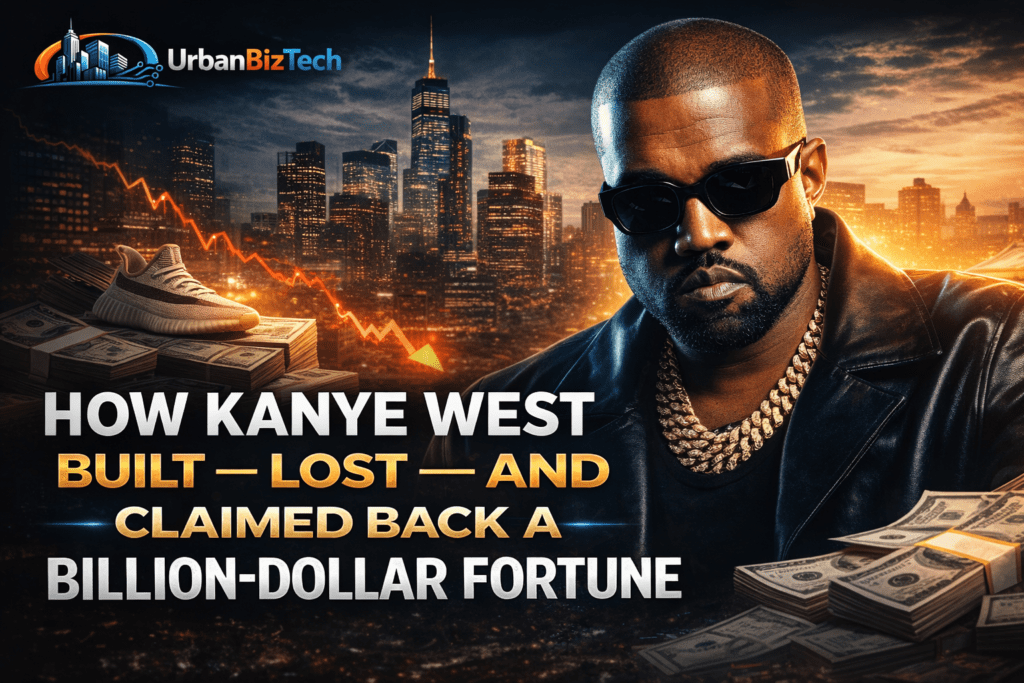
Few modern celebrity wealth stories are as volatile — or as instructive — as that of Kanye West, now legally known as Ye.
In less than five years, West rose to billionaire status, lost the title after a corporate fallout that erased an estimated $1.5 billion in value, and later resurfaced claiming a net worth north of $2.7 billion.
This is not just a story about music or sneakers. It’s a case study in intellectual property ownership, brand leverage, corporate dependency, and the fragile nature of valuation.
The Foundation: Music Catalog As Long-Term Asset
Before fashion, before controversy, there was music.
West built his early fortune producing for major artists in the early 2000s, later transitioning into a solo career that generated multi-platinum albums, global tours, and publishing royalties.
Unlike many artists who sell their masters, West retained significant control over his catalog. That catalog continues to generate recurring income from:
- Streaming platforms
- Licensing deals
- Publishing royalties
- Commercial placements
Music alone did not make him a billionaire. But it provided something more important: cash flow and leverage.
Yeezy: The Billion-Dollar Multiplier
The real inflection point came with Yeezy.
After an early partnership with Nike, West left over royalty and ownership disputes. His move to Adidas changed everything.
Under Adidas, Yeezy became one of the most profitable celebrity-driven fashion lines in history.
At its peak:
- Annual sales reportedly approached $2 billion
- Royalty structures heavily favored West
- The brand accounted for a significant share of Adidas’s profit growth
In 2020–2021, major financial publications estimated West’s net worth between $1.8 billion and $2 billion — largely driven by the valuation of Yeezy’s partnership with Adidas.
The key insight: West didn’t just endorse products. He negotiated ownership and royalties.
That distinction made him a billionaire.
The 2022 Collapse: When Corporate Risk Materialized
In 2022, following controversial public statements, Adidas terminated its partnership with West.
The consequences were immediate.
Financial publications revised his net worth downward from roughly $2 billion to approximately $400 million — reflecting the loss of the Adidas-backed valuation of Yeezy.
In effect, a single corporate partnership had been responsible for the majority of his billionaire status.
Other companies, including Gap Inc., also cut ties.
The episode illustrates a core principle of celebrity wealth:
Dependency risk can erase paper billions overnight.
Ownership: The Asset That Survived
Despite losing Adidas distribution, West retained full ownership of the Yeezy brand and its intellectual property.
That ownership is critical.
A brand valuation depends on:
- Revenue
- Distribution capability
- Brand equity
- Profit margins
- Market demand
In 2025, West publicly shared documentation from a private valuation firm estimating his net worth at $2.77 billion, citing:
- 100% ownership of Yeezy IP
- His music portfolio
However, major financial ranking institutions have not formally reinstated him to billionaire lists based on that valuation.
This distinction matters.
A private valuation is not the same as a liquidity event.
Real Estate And Strategic Equity Stakes
Beyond music and fashion, West diversified.
Real Estate Holdings
He owns properties in California and Wyoming, though some have been sold or restructured following the Adidas fallout.
Skims Equity
West reportedly holds a minority stake (around 5%) in Skims, the shapewear company founded by Kim Kardashian.
As Skims reached multi-billion-dollar valuations in private funding rounds, even a single-digit equity stake represents substantial paper value.
Diversification helped prevent total financial collapse.
Is Kanye West A Billionaire Today?
The answer depends on methodology.
Institutional Estimates (Post-Adidas)
~$400 million (following partnership termination)
Self-Published 2025 Valuation
~$2.77 billion (based on private valuation of IP assets)
The Core Debate
- Are the valuations independently verified?
- Is there recurring revenue at scale?
- What is the liquidation value of Yeezy without a global distributor?
Until a major liquidity event — acquisition, IPO, or audited financial disclosure — the billionaire claim remains debated.
The Strategic Lessons
Kanye West’s financial arc reveals several business principles:
- Own the IP. Licensing deals build brands; ownership builds fortunes.
- Control distribution — or be vulnerable to it.
- Brand equity can exceed corporate backing — but only if monetized.
- Paper wealth is not the same as liquid wealth.
- Controversy carries measurable financial cost.
The Bigger Picture
West’s case may become one of the most studied celebrity wealth collapses and attempted rebounds of the decade.
His story sits at the intersection of:
- Creator economy economics
- Fashion vertical integration
- Intellectual property strategy
- Reputation risk
Whether he is formally reinstated as a billionaire or not, one fact is clear:
Kanye West transformed himself from artist to asset owner — and proved that in modern celebrity capitalism, ownership is everything.
Frequently Asked Questions (FAQ)
1) Is Kanye West currently a billionaire?
The answer depends on valuation standards. After Kanye West lost his partnership with Adidas in 2022, major financial publications revised his estimated net worth to around $400 million.
In 2025, West shared a private valuation estimating his net worth at $2.77 billion based largely on his ownership of Yeezy and his music catalog. However, this figure has not been universally confirmed by major wealth-ranking institutions.
2) How did Kanye West originally become a billionaire?
West’s billionaire status was primarily driven by the explosive growth of Yeezy under Adidas. At its peak, the Yeezy-Adidas partnership reportedly generated close to $2 billion in annual sales, with royalty structures that heavily favored West.
While his music career provided foundational wealth, fashion — specifically Yeezy — was the primary wealth multiplier.
3) Why did Adidas terminate its partnership with Kanye West?
In 2022, Adidas ended its relationship with West following controversial public statements. The termination removed the distribution engine behind Yeezy’s global sales, leading to a sharp downward revision of his estimated net worth.
4) Does Kanye West still own Yeezy?
Yes. Despite losing the Adidas distribution agreement, West retained full ownership of the Yeezy intellectual property. This ownership forms the basis of his later claim that his net worth rebounded into the multi-billion-dollar range.
5) What role does Kanye West’s music catalog play in his wealth?
West’s catalog generates recurring revenue through streaming, publishing royalties, licensing, and commercial placements. While it did not make him a billionaire on its own, it provides consistent cash flow and long-term asset value.
6) Does Kanye West have other significant investments?
Yes. In addition to real estate holdings, West reportedly owns a minority stake (around 5%) in Skims, the company founded by Kim Kardashian. As Skims reached multi-billion-dollar private valuations, even a small equity stake represents meaningful paper value.
7) How much did Kanye West lose after the Adidas deal ended?
Financial estimates suggest that roughly $1.5–$2 billion in paper valuation was erased when Adidas terminated the partnership. His estimated net worth dropped from around $2 billion to approximately $400 million according to major financial publications at the time.
8) What is the difference between “paper wealth” and “liquid wealth” in Kanye West’s case?
Paper wealth refers to valuation estimates based on brand equity and intellectual property. Liquid wealth refers to accessible cash or easily sellable assets. Much of West’s claimed wealth is tied to brand valuation rather than cash liquidity.
9) Could Kanye West officially return to billionaire rankings?
It is possible — but typically requires:
- Verified financial disclosures
- A major liquidity event (IPO, acquisition, or audited valuation)
- Sustained revenue at scale
Until then, billionaire claims remain subject to debate among financial analysts.
Pingback: How Kim Kardashian Became a Billionaire: From Reality TV Star to Global Entrepreneur - Urban Business Technology