
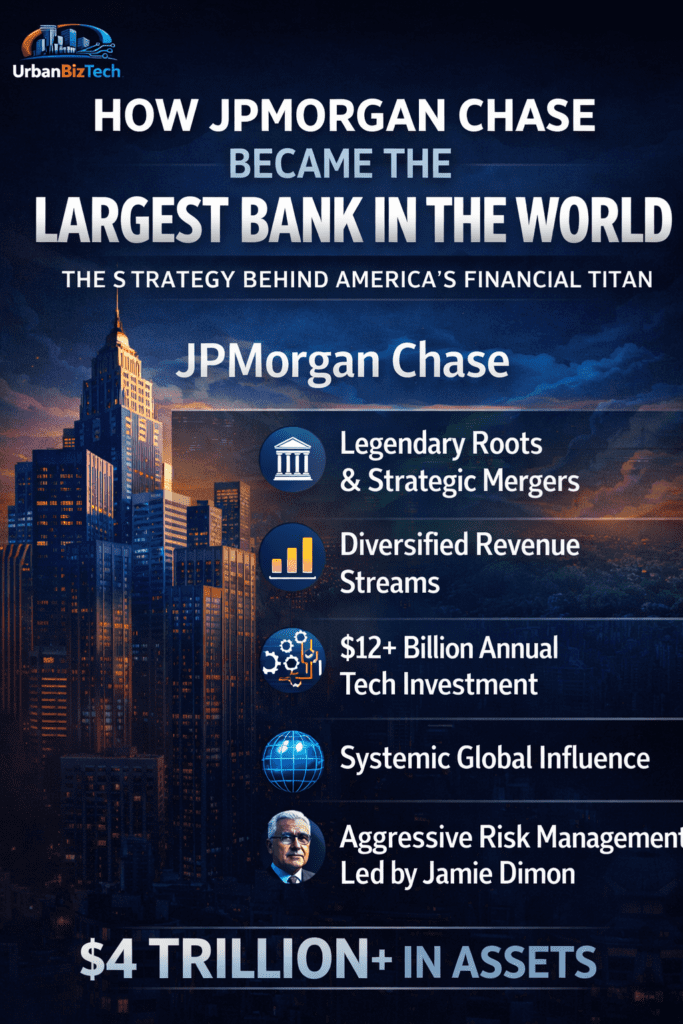
From 19th-Century Powerhouse to 21st-Century Financial Empire
Becoming the largest bank in the world is not the result of luck — it is the outcome of scale, discipline, strategic acquisitions, and relentless reinvention.
Today, JPMorgan Chase stands as the most powerful bank in the United States by assets and one of the most influential financial institutions globally. With total assets exceeding $4 trillion, record-breaking annual profits, and operations spanning more than 100 countries, the bank has evolved into something larger than a traditional lender — it is a global financial infrastructure platform.
But how exactly did JPMorgan rise above competitors like Bank of America, Citigroup, and HSBC — and what separates it from the Chinese giants such as Industrial and Commercial Bank of China?
The answer lies in five strategic pillars.
1. A Foundation Built on Crisis and Consolidation
JPMorgan’s origins trace back to the legendary financier J. P. Morgan, who famously helped stabilize the U.S. financial system during the Panic of 1907. His philosophy — disciplined capital allocation and systemic stability — remains embedded in the bank’s DNA.
The modern JPMorgan Chase was formed through decades of strategic mergers, including:
- J.P. Morgan & Co.
- Chase Manhattan Bank
- Bank One
- Bear Stearns (acquired during the 2008 crisis)
- Washington Mutual (the largest bank failure in U.S. history)
Unlike rivals that collapsed under pressure during the 2008 financial crisis, JPMorgan used the turmoil as an expansion opportunity — strengthening its investment banking dominance and expanding its retail footprint.
Scale, during crisis, became strategy.
2. Leadership That Prioritized Risk Over Hype
Since 2005, CEO Jamie Dimon has led the bank with a focus on risk management and balance-sheet strength.
While other institutions chased high-risk mortgage-backed securities prior to 2008, JPMorgan maintained stricter underwriting standards and stronger capital buffers. The result: survival — and market share gains.
Dimon’s approach centers on:
- Fortress balance sheet strategy
- Conservative liquidity management
- Aggressive but calculated acquisitions
- Long-term shareholder returns
In a sector prone to volatility, stability became competitive advantage.
3. Four Engines of Profit: A Diversified Revenue Machine
Unlike narrowly focused banks, JPMorgan operates across four major profit centers:
- Consumer & Community Banking
- Corporate & Investment Banking
- Commercial Banking
- Asset & Wealth Management
This diversification reduces earnings volatility. When investment banking slows, consumer banking or asset management can offset the impact. Few global banks achieve this level of balance at such scale.
The result: consistent profitability even amid rising interest rates, geopolitical uncertainty, and economic slowdowns.
4. A $12+ Billion Bet on Technology
JPMorgan is not just a bank — it is one of the largest technology spenders in global finance.
The firm invests over $12 billion annually in:
- Artificial intelligence
- Cybersecurity
- Cloud infrastructure
- Data analytics
- Digital banking platforms
AI is used to detect fraud, optimize trading strategies, automate compliance, and enhance customer experience. In many ways, JPMorgan increasingly resembles a fintech company embedded inside a traditional bank.
This technological edge protects margins while improving operational efficiency — a key factor in sustaining dominance.
5. Global Reach and Systemic Influence
With operations in over 100 countries, JPMorgan plays a central role in global capital flows. Its influence extends across:
- Sovereign debt markets
- Corporate bond issuance
- Currency trading
- Equity underwriting
- Liquidity provision
When JPMorgan moves, markets often react.
However, this dominance also brings scrutiny. As a “too big to fail” institution, the bank faces intense regulatory oversight and periodic legal settlements — reminders that size creates both power and vulnerability.
Is JPMorgan Truly the Largest Bank in the World?
The answer depends on definition.
- By U.S. assets: Yes, it is the largest.
- By global market influence: Arguably unmatched.
- By total global assets: Some Chinese banks, including ICBC, report higher raw asset totals.
Yet when combining profitability, global reach, investment banking dominance, and market capitalization, JPMorgan remains the most influential Western bank in the financial system.
Size alone does not define leadership. Profitability and resilience do.
The Risks Ahead
Despite its strength, challenges remain:
- Rising global interest rate volatility
- Increasing fintech competition
- Geopolitical fragmentation
- Regulatory tightening
- Digital asset disruption
Maintaining dominance will require continued innovation without compromising balance-sheet discipline — a delicate balance in an era of rapid financial transformation.
JPMorgan Chase did not become the world’s largest and most powerful bank by accident. It did so through disciplined risk management, opportunistic acquisitions, diversified revenue streams, technological investment, and consistent leadership.
In a world where financial institutions rise and fall with economic cycles, JPMorgan has mastered the art of turning volatility into opportunity.
The real question is not whether it is the largest bank today —
but whether any competitor can realistically challenge its position in the decade ahead.
Frequently Asked Questions (FAQ) About JPMorgan Chase
1. Is JPMorgan Chase the largest bank in the world?
JPMorgan Chase is the largest bank in the United States by total assets. Globally, some Chinese banks such as Industrial and Commercial Bank of China report higher total assets. However, in terms of profitability, market influence, investment banking power, and global reach, JPMorgan is widely considered the most influential Western bank.
2. How much money does JPMorgan Chase make per year?
In recent years, JPMorgan Chase has generated annual net income exceeding $40 billion, with total revenue surpassing $150 billion in strong economic cycles. Earnings fluctuate depending on interest rates, trading activity, and macroeconomic conditions.
3. Who is the CEO of JPMorgan Chase?
The CEO of JPMorgan Chase is Jamie Dimon. He has led the bank since 2005 and is regarded as one of the most influential executives on Wall Street. Under his leadership, the bank successfully navigated the 2008 financial crisis and expanded its global dominance.
4. What makes JPMorgan different from Bank of America or Citigroup?
Compared to Bank of America and Citigroup, JPMorgan stands out due to:
- Stronger investment banking franchise
- More diversified revenue streams
- Higher and more consistent profitability
- Larger technology investment budget
- A reputation for disciplined risk management
5. How did JPMorgan survive the 2008 financial crisis?
JPMorgan survived the 2008 crisis by maintaining stricter risk controls and stronger capital reserves than many competitors. During the crisis, it acquired Bear Stearns and Washington Mutual, expanding its footprint while other institutions collapsed.
6. How much does JPMorgan invest in technology?
JPMorgan invests over $12 billion annually in technology, including artificial intelligence, cybersecurity, cloud infrastructure, and data analytics. This makes it one of the largest technology spenders in the global financial sector.
7. Is JPMorgan considered “too big to fail”?
Yes. JPMorgan is classified as a systemically important financial institution (SIFI). This means regulators consider it critical to the stability of the global financial system, subjecting it to stricter oversight and higher capital requirements.
8. In how many countries does JPMorgan operate?
JPMorgan operates in more than 100 countries worldwide, providing services ranging from retail banking to global investment banking and asset management.
9. What are the biggest risks facing JPMorgan today?
Major risks include:
- Interest rate volatility
- Global economic slowdown
- Geopolitical tensions
- Regulatory tightening
- Competition from fintech and digital asset platforms
10. Could another bank overtake JPMorgan?
While Chinese banks may exceed JPMorgan in raw asset size, overtaking it in global influence, profitability, and investment banking dominance would require a rare combination of scale, stability, and strategic execution.
Pingback: Top Private Banks for Wealth Management and Family Offices: Best Private Banks for Wealth Management and Family Offices (2026 Guide)
Pingback: Wall Street: The Rise of the World’s Most Powerful Financial Hub
Pingback: Kevin Hart Net Worth 2026: How He Built a $650M Media Empire
Pingback: Best Private Banks & Wealth Management Firms in the U.S.
Pingback: Best Banks in Singapore (2026): Top Banks for Investors, Businesses & Wealth Management