
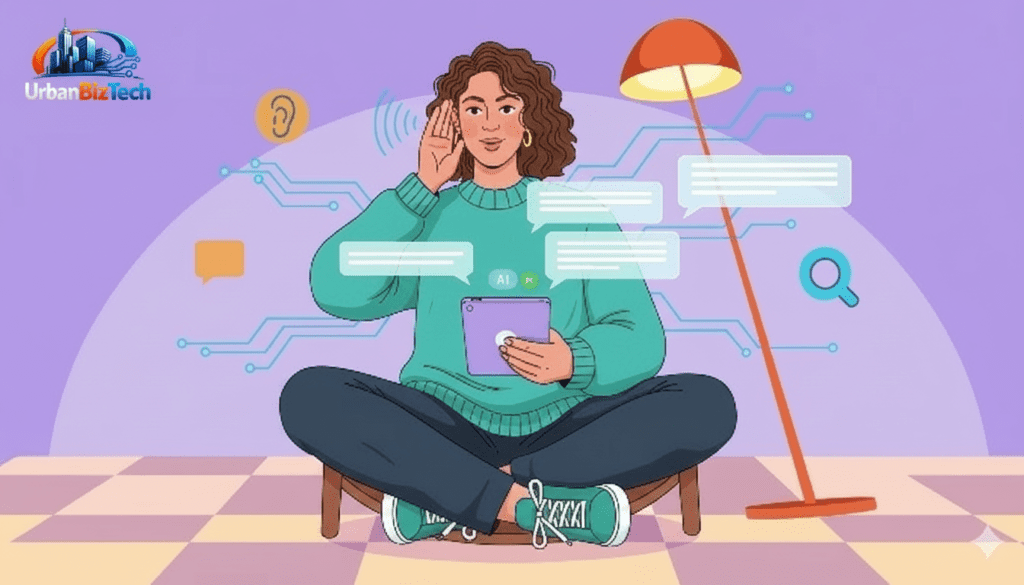
🧠 The Listening Crisis in the Digital Age
In today’s world, filled with notifications and social media distractions, the skill of true listening has become increasingly rare. Many people hear but do not truly listen—they interrupt, jump to conclusions, or offer solutions before fully understanding. This habit affects relationships and diminishes our ability to understand others deeply.
Surprisingly, artificial intelligence (AI)—despite being a machine—has shown the ability to simulate listening in ways that could help us improve our daily interactions.
💬 AI as a Mirror of Our Communication Habits
Chatbots and intelligent systems demonstrate several qualities that can enhance human interactions:
- Full focus on the speaker: They never interrupt.
- No pre-judgment: Responses are neutral and unbiased.
- Space for free expression: Users can share their thoughts and feelings without restrictions.
These traits allow for a smooth interactive experience, making users feel more comfortable and open than they often do with humans.
👂 Lessons We Can Learn from AI
1. Patience and Avoiding Interruptions
One of the most important listening skills is not interrupting the speaker. AI consistently models this behavior, whereas humans often rush, interrupt, or provide solutions before the other person finishes.
2. Listening Without Pre-Judgment
Listening without quick evaluation improves conversation quality and makes speakers feel safe. AI shows us a practical example of neutral listening.
3. Enhancing Empathy Through Neutral Responses
Although machines lack true emotions, users often perceive AI responses as more compassionate and understanding, highlighting the importance of showing empathy in dialogue.
4. Attention to Details
AI analyzes conversations carefully without missing any information. Humans may get distracted, but focusing on details enhances understanding and clarity.
📊 Practical Examples
- In AI-assisted psychotherapy sessions, patients feel more comfortable speaking to a machine because it does not judge, encouraging openness and honesty.
- In workplace settings, AI tools that record and analyze meetings help teams identify misunderstandings and improve internal communication.
🚀 The Limits of AI
Despite its benefits, AI has clear limitations:
- It is not a substitute for human relationships.
- It lacks the ability for true emotional understanding or deep empathy.
- It can teach us techniques, but it cannot replace the human dimension of emotional communication.
🌟 How to Apply These Lessons in Daily Life
- Listen without interrupting others.
- Focus on understanding ideas before making judgments.
- Allow space for full expression of thoughts and feelings.
- Pay attention to key details and confirm understanding by paraphrasing what you heard.
🔍 Listening as a Life Skill
AI is not just a tool—it is a mirror for our communication habits. By observing its behavior, we can learn patience, withholding judgment, empathy, and focus. Yet, the human ability for deep emotional connection remains a skill no machine can replicate.
Frequently Asked Questions (FAQ) – How AI Can Teach Us to Listen
1. What is true listening, and why is it important?
True listening means giving someone your full attention, understanding their ideas, and responding thoughtfully without interrupting or judging. It is essential for building trust, improving relationships, and effective communication in both personal and professional life.
2. How can artificial intelligence improve human listening skills?
AI can model key listening behaviors, such as:
- Not interrupting the speaker
- Avoiding quick judgment
- Focusing on details
- Responding with empathy
Observing these behaviors can help humans become better listeners and communicators.
3. Can AI replace human interaction?
No. AI is a tool for learning and practicing good listening habits, but it cannot replace genuine human emotional connection and understanding.
4. What practical examples show AI improving listening?
- In AI-assisted therapy sessions, patients feel more comfortable expressing themselves freely.
- In workplace communication, AI tools that record and analyze meetings help teams identify misunderstandings and improve collaboration.
5. How can I apply AI listening lessons in real life?
- Listen without interrupting
- Avoid judging too quickly
- Give space for full expression
- Pay attention to details and confirm understanding
By practicing these habits, you can enhance your personal and professional communication skills.
6. Is it safe to rely on AI for improving empathy?
AI cannot feel true empathy, but it can simulate compassionate responses, which teaches humans how to communicate more thoughtfully. Always combine AI guidance with real human emotional awareness.
Pingback: ChatGPT vs Gemini vs Grok vs Perplexity vs Claude in 2026: Which AI Model Is Best for You? - Urban Business Technology
Pingback: The Most Dangerous Jobs at Risk of Disappearing Because of AI: The 2026 Labor Market Map - Urban Business Technology
Pingback: ChatGPT vs DeepSeek in 2026: The Ultimate Comparison for Content, Coding, and Cost - Urban Business Technology
Pingback: Why Global Giants Are Racing to Dominate Artificial Intelligence in 2026
Pingback: Top 9 Benefits of Artificial Intelligence in 2026: How AI Is Transforming the Global Economy