
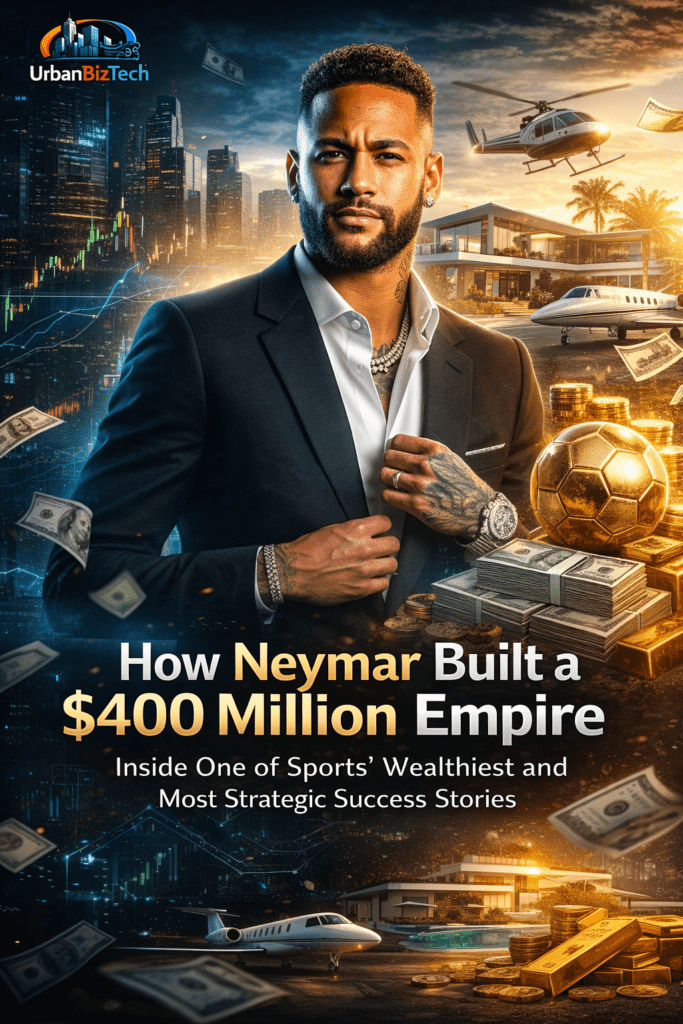
In modern sports economics, few case studies are as layered — and as commercially sophisticated — as Neymar Jr.
More than a footballer, Neymar represents the evolution of the 21st-century athlete: a hybrid of elite performer, global brand, media property, and investment vehicle.
As of 2025, credible industry estimates place his net worth between $350 million and $420 million, built through record-shattering transfers, elite-tier salaries, multinational endorsement portfolios, and diversified investments. And if a reported Brazilian inheritance case is legally confirmed, that figure could rise dramatically.
Here is the financial anatomy of Neymar’s empire.
1. The Foundation: From Santos FC Prodigy to Global Asset
Born in São Paulo, Neymar emerged from Santos FC as Brazil’s most marketable football export since the early 2000s.
Unlike many rising stars, Neymar monetized early. By age 17, he was already securing local sponsorship agreements. His camp understood something critical: modern football wealth isn’t built solely on performance — it’s built on narrative, visibility, and brand positioning.
By the time Europe called, Neymar was not just a talent. He was an appreciating commercial asset.
2. FC Barcelona: The Globalization Phase
In 2013, Neymar joined FC Barcelona in a move that reshaped his commercial trajectory.
While not the most expensive transfer at the time, it placed him inside one of the most powerful sports marketing ecosystems in the world. Playing alongside global icons amplified:
- His salary and performance bonuses
- His global media exposure
- His sponsorship leverage
At Barcelona, Neymar transitioned from Brazilian superstar to worldwide brand.
3. The $263 Million Shockwave: Paris Saint-Germain
In 2017, Paris Saint-Germain triggered Neymar’s €222 million release clause (approximately $263 million at the time), making it the most expensive transfer in football history — a record that still stands.
This was not merely a transfer. It was a financial inflection point.
His PSG contract reportedly included:
- Annual compensation exceeding $70 million at peak structure
- Massive signing bonuses
- Commercial image rights advantages
- Strategic positioning as the club’s global face
The move multiplied his brand valuation and negotiating power across industries.
4. The Saudi Expansion: Al Hilal
In 2023, Neymar joined Al Hilal in Saudi Arabia — a region aggressively investing in global sports assets.
The deal reportedly included:
- One of the highest annual salary packages in world football
- Commercial activation agreements tied to Middle Eastern markets
- Lifestyle and performance incentives
This phase marked geographic diversification of his earning base — a hallmark of financially strategic athletes.
5. Brand Power: The Endorsement Machine
For elite athletes, endorsements often rival — or exceed — salaries. Neymar exemplifies this model.
Over the years, his portfolio has included global partnerships with:
- Nike (before transitioning to Puma in 2020)
- Puma
- Red Bull
- Beats by Dre
- Qatar Airways
- Gillette
- Diesel
At peak commercial periods, endorsement income alone has been estimated in the tens of millions annually.
With more than 200 million social media followers, Neymar operates as a direct-to-consumer media channel — reducing reliance on traditional advertising funnels and strengthening brand control.
6. Investment Strategy: Beyond the Pitch
High earnings do not guarantee sustained wealth. Preservation and growth require allocation strategy.
Neymar’s portfolio reportedly includes:
- Luxury real estate in Brazil and Europe
- Early-stage investments in technology ventures
- Entertainment and content production projects
- Fashion and lifestyle branding initiatives
Diversification reduces exposure to the short career span of professional athletes and converts income into appreciating assets.
7. Lifestyle vs. Liquidity
Neymar’s lifestyle — private jets, luxury vehicles, multiple residences — is frequently scrutinized. However, at his earning velocity, such expenditures represent a manageable fraction of cumulative income.
Elite wealth analysis distinguishes between high consumption and over-leverage. To date, there is no verified indication that lifestyle spending materially threatens his net position.
8. The Billion-Dollar Inheritance Report
In 2025, Brazilian media reported that a businessman without heirs intended to leave a fortune reportedly approaching $1 billion to Neymar.
The matter remains subject to legal validation in Brazil, and no final judicial confirmation has been issued.
If validated, the inheritance would place Neymar among the wealthiest athletes in modern history — not solely through sport, but through capital transfer.
Until confirmed, it remains a potential upside variable rather than booked net worth.
9. Comparative Positioning in the Athlete Wealth Hierarchy
Within global football’s financial elite — alongside figures such as Cristiano Ronaldo and Lionel Messi — Neymar occupies a distinct lane:
- Younger peak monetization phase
- Aggressive transfer-driven income spikes
- Strong emerging-market brand influence
Unlike athletes whose wealth is built on longevity alone, Neymar’s case reflects high-impact financial events concentrated over a decade.
10. The Modern Athlete as Enterprise
Neymar’s fortune illustrates a broader structural shift in sports economics:
Today’s elite athlete is:
- A salary earner
- A licensing platform
- A media network
- An investment entity
- A geopolitical soft-power asset
His wealth was not built merely through goals scored — but through leverage maximization at every career inflection point.
Neymar is no longer just a footballer.
He is a capital structure.
From Santos to Barcelona, from Paris to Saudi Arabia, from sponsorship ecosystems to diversified assets, his trajectory reflects the industrialization of individual athletic brands.
If current projections hold, and if pending legal variables resolve favorably, Neymar’s financial story may ultimately be remembered not for its transfer fees — but for its transformation of talent into scalable global equity.
Frequently Asked Questions (FAQ) About Neymar Jr.’s Net Worth
1) What is Neymar Jr.’s net worth in 2026?
As of 2025, credible industry estimates place Neymar’s net worth between $350 million and $420 million, depending on contract structures, bonuses, endorsement income, and asset valuations.
2) How does Neymar earn most of his money?
Neymar’s wealth comes from four primary streams:
- Club salaries and bonuses (from teams including FC Barcelona, Paris Saint-Germain, and Al Hilal)
- Endorsements and sponsorships
- Image rights and commercial licensing
- Private investments and real estate
3) Was Neymar’s transfer to Paris Saint-Germain really the most expensive ever?
Yes. In 2017, Paris Saint-Germain activated his €222 million release clause from FC Barcelona (approximately $263 million at the time), making it the most expensive transfer in football history to date.
4) How much did Neymar earn at Al Hilal?
While exact figures vary by source, reports indicate that his contract with Al Hilal placed him among the highest-paid footballers globally, with a compensation package potentially exceeding $100 million annually when bonuses and commercial rights are included.
5) How much does Neymar make from endorsements?
At peak commercial periods, endorsement income alone has been estimated in the tens of millions of dollars annually.
Major brand partnerships have included:
- Nike (before switching to Puma)
- Puma
- Red Bull
- Beats by Dre
- Qatar Airways
- Gillette
- Diesel
6) Does Neymar own businesses or investments?
Yes. Neymar has reportedly invested in:
- Luxury real estate in Brazil and Europe
- Technology startups
- Entertainment and media ventures
- Fashion and lifestyle branding
These investments help diversify his wealth beyond football earnings.
7) What is the reported $1 billion inheritance story?
Brazilian media reported in 2025 that a businessman without heirs intended to leave a fortune — reportedly approaching $1 billion — to Neymar.
The matter remains subject to legal confirmation and has not been finalized in court.
8) How does Neymar compare financially to Cristiano Ronaldo and Lionel Messi?
While Ronaldo and Messi currently hold higher total net worth estimates due to longevity and sustained commercial dominance, Neymar remains among the wealthiest active footballers globally, with one of the highest single-transfer financial spikes in history.
9) Does Neymar’s lifestyle affect his wealth?
Despite a high-profile luxury lifestyle — including multiple properties and private travel — there is no verified evidence suggesting financial instability. His earnings scale comfortably supports his spending patterns.
10) Is Neymar still growing his wealth after returning to Santos?
If reports of a return to Santos FC materialize, the move would likely be more strategic than financial — reinforcing brand equity in Brazil while maintaining global sponsorship income streams.
Pingback: How Nike Became the Largest Sportswear Company in the World
Pingback: How Red Bull Built a Global Empire: Marketing Strategy, Media Power & Sports Ownership