
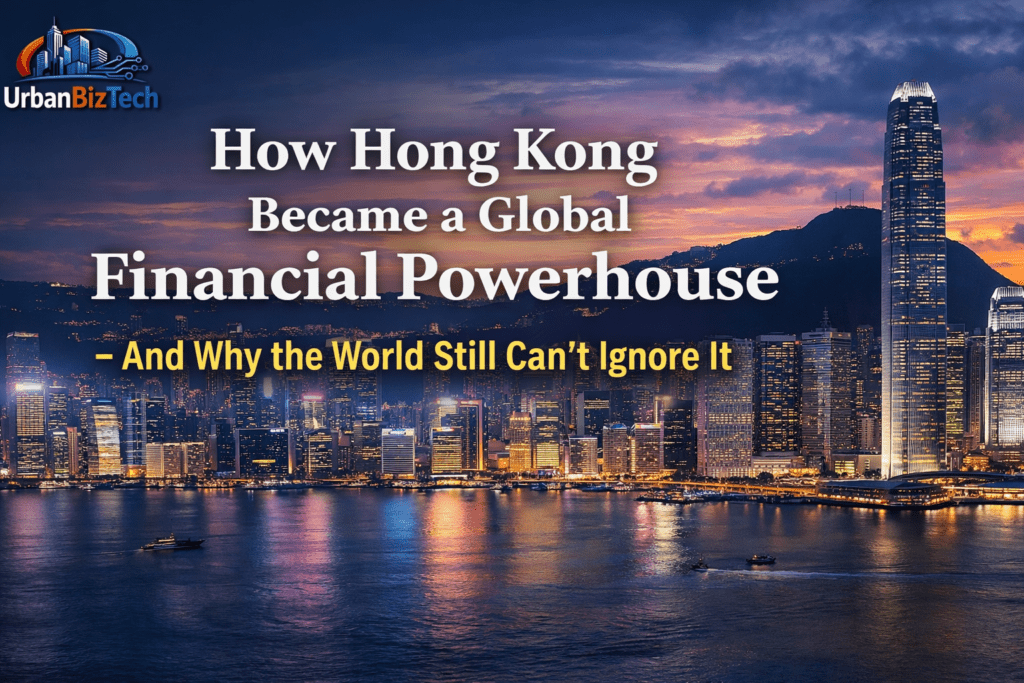
In global finance, some cities facilitate capital flows. Others shape them.
Hong Kong belongs to the latter.
From the skyline overlooking Victoria Harbour, billion-dollar IPOs are structured, cross-border capital moves in complex networks, and East meets West in one of the most sophisticated financial ecosystems ever built in Asia.
Despite rising competition from Singapore and mounting geopolitical pressures, Hong Kong remains a cornerstone of global capital markets.
But how did a small, resource-poor territory transform itself into one of the most important financial centers in the world?
From Free Port to Financial Command Center
Hong Kong’s financial rise was not accidental — it was engineered over decades.
Under British administration, the city developed a reputation for:
- Free trade
- Strong property rights
- Low and simple taxation
- Minimal capital controls
By the mid-20th century, it had evolved from a trading port into a manufacturing hub. But when China’s industrial rise accelerated in the 1980s, Hong Kong pivoted again — this time toward finance, logistics, and professional services.
That pivot changed everything.
Instead of competing with factories, the city began structuring deals, raising capital, and managing wealth for a rapidly integrating Asia.
The Institutional Backbone of Trust
Global investors don’t chase opportunity alone — they demand certainty.
Hong Kong built that certainty through powerful institutions, including:
- Hong Kong Monetary Authority (HKMA), which safeguards monetary stability and manages the currency peg to the U.S. dollar.
- Securities and Futures Commission (SFC), the independent market regulator enforcing transparency and investor protection.
- Hong Kong Exchanges and Clearing (HKEX), operator of one of the world’s largest stock markets by market capitalization.
This framework mirrors Western legal standards while remaining deeply integrated with Asia — a rare dual advantage.
The China Advantage: A Financial Gateway Like No Other
Hong Kong’s most powerful strategic asset is its unique position within China’s economic architecture.
Since its 1997 handover, the city has operated under the “one country, two systems” framework, allowing it to maintain:
- A common law system
- Independent courts
- Free capital mobility
- International financial standards
For Chinese companies, Hong Kong offers access to international capital.
For global investors, it provides exposure to China within a familiar regulatory environment.
This two-way bridge has made the city indispensable in cross-border finance.
IPO Capital and Billion-Dollar Deal Flow
Over the past two decades, some of the largest IPOs of Chinese firms have been executed in Hong Kong. International banks, hedge funds, and asset managers have built major regional headquarters there.
The financial services sector contributes roughly a quarter of the city’s GDP and employs hundreds of thousands of professionals — from investment bankers to quantitative analysts.
Its capital markets are deep, liquid, and globally connected — critical attributes during periods of volatility.
Rising Competition: The Singapore Factor
No discussion of Hong Kong’s future is complete without mentioning Singapore.
Singapore has aggressively expanded in:
- Private banking
- Family office services
- Wealth management
- FinTech innovation
Its political stability and strategic positioning have attracted significant private capital in recent years.
Yet Hong Kong retains a structural advantage: direct access to mainland Chinese enterprises and investors — a scale that is difficult for competitors to replicate.
Geopolitics and Market Resilience
Tensions between China and Western economies have prompted investors to reassess risk exposure.
Some multinational firms diversified operations. Certain rankings of global financial centers saw shifts.
However, capital markets are ultimately pragmatic. Investors return to liquidity, opportunity, and scale — and Hong Kong continues to offer all three.
Its currency peg to the U.S. dollar remains intact.
Its equity markets remain among the largest globally.
Its banking system remains deeply capitalized.
Reinvention: Green Finance and Offshore RMB
Rather than retreat, Hong Kong is repositioning.
It is expanding its role in:
- Offshore renminbi (RMB) clearing
- Green bond issuance
- Sustainable finance platforms
- Cross-border investment channels with mainland exchanges
This strategic recalibration may define its next growth phase.
Why Hong Kong Still Matters
Even amid global uncertainty, Hong Kong retains enduring advantages:
- Decades of financial expertise
- A trusted legal system
- Deep institutional liquidity
- A convertible currency linked to the U.S. dollar
- Proximity to the world’s second-largest economy
Few financial centers combine all of these elements at scale.
Hong Kong’s story is not one of uninterrupted ascent — it is one of adaptation.
Each decade has tested its resilience. Each time, it has recalibrated.
The real question is not whether Hong Kong remains relevant.
It is how its role will evolve in a multipolar financial world increasingly shaped by Asia.
For global investors, one fact remains clear:
In Asia’s capital markets, Hong Kong is still a city you cannot afford to ignore.
Frequently Asked Questions (FAQ)
1. Why is Hong Kong considered a global financial center?
Hong Kong is considered a global financial center because of its open capital markets, low tax regime, common law legal system, deep stock exchange, and strategic position as a gateway between China and international investors. Its financial infrastructure supports IPOs, wealth management, asset trading, and offshore renminbi transactions at global scale.
2. How important is Hong Kong’s stock exchange globally?
Hong Kong Exchanges and Clearing (HKEX) operates one of the largest stock markets in the world by market capitalization. It has consistently ranked among the top global venues for IPO fundraising, particularly for Chinese companies seeking international capital.
3. What role does Hong Kong play in China’s economy?
Hong Kong serves as China’s primary international financial gateway. It facilitates foreign investment into mainland China and enables Chinese firms to access global capital markets. It is also a major offshore hub for renminbi (RMB) clearing and settlement.
4. How does Hong Kong compare to Singapore as a financial hub?
Singapore is a strong competitor, especially in wealth management, private banking, and family offices. However, Hong Kong maintains a structural advantage due to its direct integration with mainland China’s economy and capital markets.
5. What institutions regulate Hong Kong’s financial system?
The financial system is overseen by:
- Hong Kong Monetary Authority (HKMA), responsible for monetary stability and the currency peg.
- Securities and Futures Commission (SFC), which regulates securities and futures markets.
These institutions help maintain transparency, liquidity, and investor confidence.
6. Is Hong Kong’s currency stable?
Yes. The Hong Kong dollar operates under a linked exchange rate system pegged to the U.S. dollar. This arrangement has been maintained for decades and provides exchange rate stability for investors and businesses.
7. Has Hong Kong lost its status as a financial center?
While geopolitical tensions and regional competition have created challenges, Hong Kong remains one of the world’s leading financial hubs. It continues to rank highly in global financial center indices and maintains strong capital market activity.
8. What are the biggest risks facing Hong Kong’s financial future?
Key risks include:
- Intensifying competition from regional financial centers
- Geopolitical tensions affecting capital flows
- Regulatory changes impacting multinational operations
- The global shift toward digital finance and FinTech innovation
However, its deep institutional base and integration with China provide long-term resilience.
9. Why do global investors still choose Hong Kong?
Investors choose Hong Kong for:
- Access to Chinese markets
- Deep liquidity
- A familiar legal framework
- Strong financial regulation
- International banking infrastructure
These advantages remain difficult to replicate elsewhere in Asia.
10. What is the future outlook for Hong Kong’s financial sector?
Hong Kong is expanding into green finance, sustainable bonds, offshore RMB services, and cross-border investment programs. Its future role will likely center on being China’s international capital platform while adapting to a more multipolar financial world.
Pingback: Top Private Banks for Wealth Management and Family Offices: Best Private Banks for Wealth Management and Family Offices (2026 Guide)
Pingback: How Singapore Became Asia’s Top Wealth Hub | Family Office & Asset Management Growth
Pingback: How the Cayman Islands Became a Global Hub for Offshore Companies & Wealth Management
Pingback: Hong Kong vs Singapore: The $10 Trillion Battle for Asia’s Wealth Management Supremacy (2026 Guide)
Pingback: Wall Street: The Rise of the World’s Most Powerful Financial Hub
Pingback: Inside London: The Rise of a Global Financial Capital
Pingback: Inside Bloomberg: The $100 Billion Data Empire Powering Global Finance
Pingback: How Jackie Chan Built a $400 Million Fortune: The Business Strategy Behind a Global Action Icon