
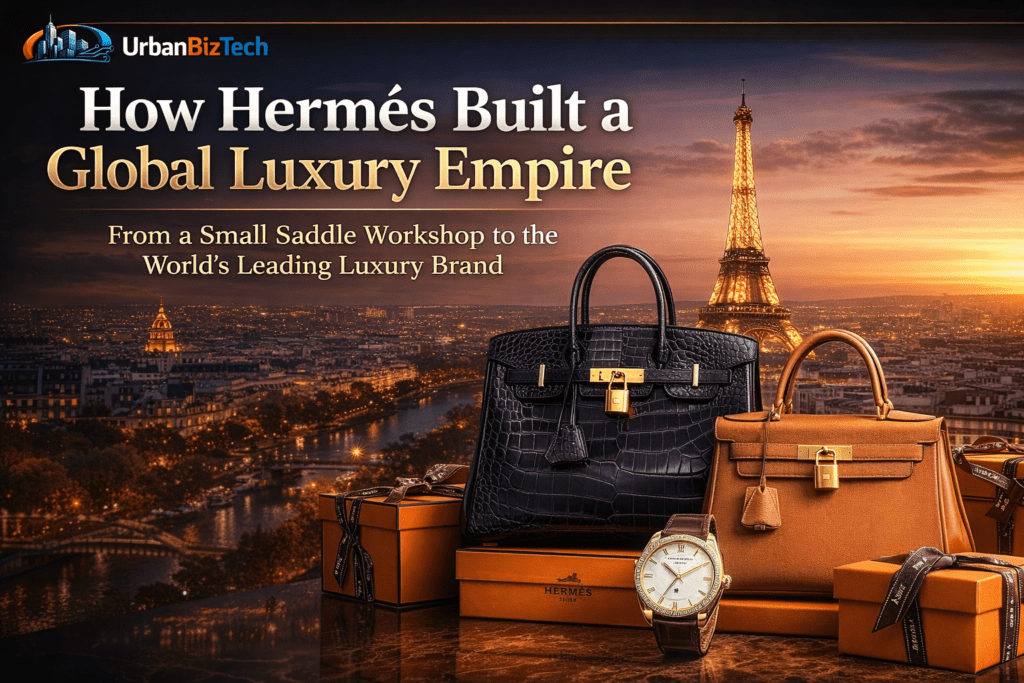
From a Small Parisian Saddle Workshop to One of the Most Powerful Luxury Brands in the World
Few luxury brands in history have achieved the level of mystique, exclusivity, and long-term dominance of Hermès.
Unlike many modern fashion houses driven by aggressive marketing and rapid expansion, Hermès followed a radically different strategy: craftsmanship first, scarcity by design, and patience over profit maximization.
Today, the Parisian house stands among the most valuable luxury companies in the world, with a market capitalization exceeding $200 billion and a reputation that many competitors struggle to replicate.
But the Hermès story did not begin with fashion shows or handbags.
It began with horses.
The Origins of Hermès: A Saddle Maker for European Nobility
1837 — The Birth of a Craftsmanship Legacy
The story begins in 1837, when Thierry Hermès founded a small workshop in Paris dedicated to crafting high-quality horse harnesses and saddles.
At the time, horses were the primary mode of transportation for Europe’s elite. Wealthy aristocrats and noble families demanded equipment that was not only functional but beautifully crafted.
Thierry Hermès built his reputation on three principles:
- precision craftsmanship
- durable materials
- meticulous attention to detail
His workshop quickly gained recognition among European aristocracy.
By the mid-19th century, Hermès products had already won prestigious awards at international exhibitions, establishing the company as a master of leather craftsmanship.
The First Strategic Pivot: From Horse Equipment to Luxury Leather Goods
Adapting to the Age of Automobiles
As the 19th century drew to a close, transportation began to change dramatically.
Automobiles were gradually replacing horses, threatening the entire saddle industry.
Many saddle makers disappeared.
Hermès adapted.
Under the leadership of Thierry’s son, Charles-Émile Hermès, the company pivoted toward leather goods and travel accessories.
In 1880, the company moved its headquarters to what would become one of the most famous retail addresses in fashion history:
24 Faubourg Saint‑Honoré
This location remains the global flagship store of Hermès today.
The transition marked the beginning of Hermès as a luxury lifestyle brand rather than a specialized craftsman workshop.
Innovation Without Compromising Tradition
Hermès built its reputation not only on craftsmanship but also on quiet innovation.
One of its most notable innovations occurred in the early 20th century when the company introduced the zipper to France after collaborating with the inventor of the fastening mechanism.
Hermès integrated the zipper into leather travel bags, a revolutionary idea at the time.
Another iconic product from this period was the Haut à Courroies bag, originally designed to carry equestrian gear.
It would later inspire what became some of the most famous handbags in the world.
The Kelly Bag: A Royal Moment That Changed Fashion History
One of the most powerful turning points in Hermès history occurred in 1956.
That year, the actress and Princess of Monaco, Grace Kelly, was photographed using a Hermès handbag to shield her pregnancy from paparazzi.
The image spread around the world.
Demand for the bag exploded.
Soon after, Hermès officially renamed the design:
The Kelly Bag
Kelly bag became one of the most recognizable handbags in fashion history and established Hermès as a global luxury powerhouse.
The Birkin Bag: The World’s Most Famous Luxury Handbag
If the Kelly bag made Hermès famous, the Birkin bag made it legendary.
In the early 1980s, Hermès executive Jean‑Louis Dumas happened to sit next to British actress and singer Jane Birkin on a flight from Paris to London.
Birkin complained about how difficult it was to find a stylish yet practical handbag.
Dumas sketched a design on the back of an airplane sickness bag.
The result became the iconic:
Birkin bag
Today the Birkin is widely considered the most exclusive handbag in the world.
Its appeal is driven by several factors:
- handmade construction by a single artisan
- extremely limited production
- rare materials such as crocodile leather
- multi-year waiting lists
Some rare models sell for hundreds of thousands of dollars at auction.
In certain cases, Birkin bags have even outperformed traditional financial assets in resale value.
The Strategy of Scarcity: Why Hermès Refuses Mass Production
One of Hermès’ most unusual business decisions is its deliberate refusal to scale production aggressively.
Unlike many luxury competitors such as:
- Louis Vuitton
- Gucci
Hermès maintains strict control over production volume.
Each handbag can take 15 to 25 hours of work and is crafted entirely by one artisan trained in the company’s workshops.
This approach accomplishes three critical strategic goals:
1. It preserves craftsmanship quality.
2. It creates extreme scarcity.
3. It protects long-term brand value.
Rather than chasing short-term profits, Hermès protects its image as a true luxury house.
Minimal Advertising, Maximum Prestige
Another unusual aspect of the Hermès strategy is its limited reliance on traditional marketing.
The company rarely uses aggressive advertising campaigns compared with other luxury brands.
Instead, Hermès focuses on:
- storytelling
- heritage
- craftsmanship
- in-store experience
The brand’s flagship boutiques are designed to feel more like cultural spaces than commercial stores.
Customers often develop personal relationships with sales associates, further reinforcing loyalty and exclusivity.
A Family-Controlled Empire in an Industry of Conglomerates
While most luxury brands are now owned by large conglomerates, Hermès remains largely controlled by the founding family.
This independence proved crucial during a dramatic corporate battle in 2010.
Luxury conglomerate LVMH, led by Bernard Arnault, quietly accumulated a large stake in Hermès in what appeared to be an attempted takeover.
The Hermès family responded by forming a holding structure to consolidate their shares and maintain control.
The move protected the company’s independence and preserved its long-term strategic vision.
Hermès Today: One of the Most Valuable Luxury Brands on Earth
Nearly two centuries after its founding, Hermès stands as one of the most powerful names in global luxury.
Key facts about Hermès today:
- Founded: 1837
- Headquarters: Paris
- Market value: over $200 billion
- Employees: more than 20,000 worldwide
- Products: leather goods, fashion, watches, jewelry, perfumes, and home design
Despite global expansion, Hermès continues to produce most of its leather goods in France to maintain craftsmanship standards.
Lessons from Hermès: How to Build a Timeless Luxury Brand
The Hermès strategy offers valuable insights for entrepreneurs and luxury brand builders.
1. Craftsmanship builds credibility
True luxury begins with exceptional product quality.
2. Scarcity creates desire
Limiting supply can increase perceived value.
3. Heritage is a strategic asset
Brand history can be one of the most powerful marketing tools.
4. Slow growth can outperform rapid expansion
Hermès grew gradually while maintaining control of its identity.
5. Independence protects long-term vision
Family ownership allowed Hermès to resist short-term market pressures.
The Real Secret Behind Hermès’ Success
Hermès did not become one of the world’s most prestigious luxury brands by following trends.
Instead, it followed a philosophy that few companies are willing to embrace:
patience, craftsmanship, and scarcity over speed and scale.
From a small saddle workshop in Paris to a global luxury empire, Hermès proves that true luxury is not just about price.
It is about heritage, craftsmanship, and the power of rarity.
Frequently Asked Questions About Hermès
What is Hermès famous for?
Hermès is globally famous for its handcrafted luxury products, especially its iconic handbags such as the Birkin bag and the Kelly bag.
The brand is known for:
- exceptional leather craftsmanship
- limited production and exclusivity
- high-quality materials
- timeless design
Unlike many luxury brands, Hermès focuses on craftsmanship and scarcity rather than mass production.
Why are Hermès bags so expensive?
Hermès bags are expensive because they are handmade by highly trained artisans and produced in limited quantities.
Key factors behind the price include:
- handcrafted production that can take 15–25 hours per bag
- rare materials such as crocodile and exotic leather
- strict quality control
- extremely limited supply
This scarcity significantly increases demand and resale value.
How long is the waiting list for a Birkin bag?
The waiting time for a Birkin bag can vary widely depending on the model, leather type, and store.
Typical waiting periods range from:
- several months
- to multiple years for rare versions
In many cases, Hermès clients must also develop a purchase history with the brand before being offered a Birkin.
Who founded Hermès?
Hermès was founded in 1837 by French craftsman Thierry Hermès in Paris.
The company originally specialized in luxury saddles and horse harnesses for European nobility before expanding into leather goods and fashion.
Is Hermès owned by LVMH?
No.
Despite an attempted stake accumulation by luxury conglomerate LVMH led by Bernard Arnault, Hermès remains largely controlled by the Hermès family.
This independence is considered one of the reasons the brand has maintained its strong identity and long-term strategy.
Why is the Birkin bag considered an investment?
Many collectors consider the Birkin bag an investment because its value often increases over time.
Rare models have sold at auction for hundreds of thousands of dollars, sometimes outperforming traditional assets such as stocks or gold.
Limited production and strong global demand contribute to its high resale value.
Where are Hermès products made?
Most Hermès leather goods are still manufactured in France in specialized workshops operated by the company.
This allows Hermès to maintain strict control over craftsmanship and product quality.
Pingback: How Bernard Arnault Built LVMH: The Strategy Behind the World’s Most Powerful Luxury Empire