
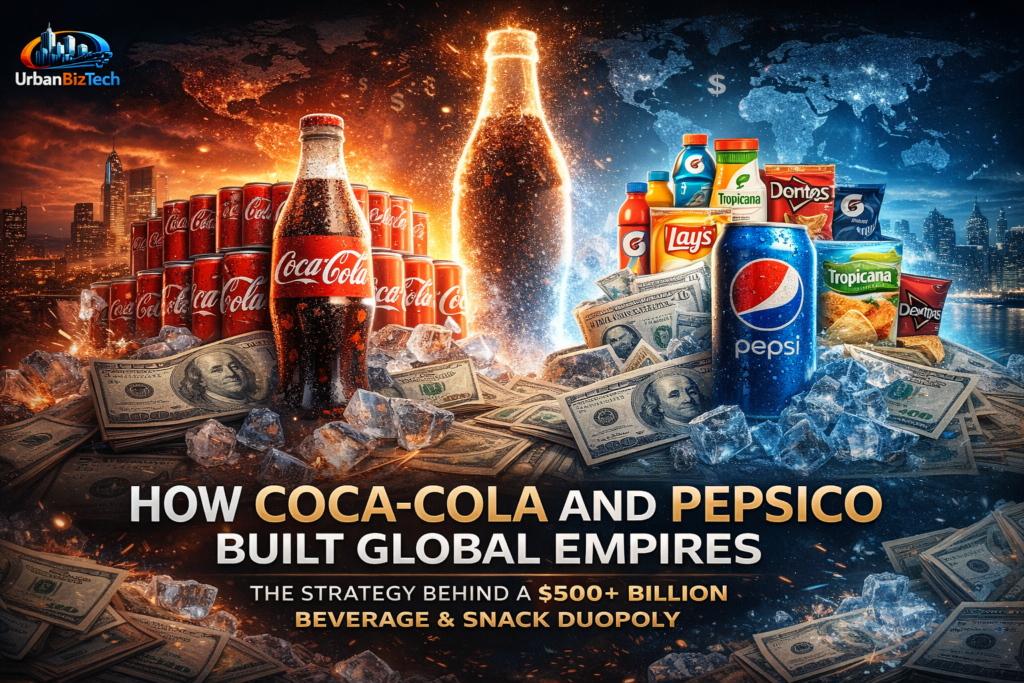
For over a century, two American corporations have shaped not just what the world drinks — but what it eats.
What began as a pharmacy tonic in 1886 evolved into one of the most powerful brand ecosystems in history. What started as a cola rival transformed into a diversified food and beverage powerhouse. Today, The Coca-Cola Company and PepsiCo collectively generate over $150 billion in annual revenue, operate in more than 200 countries, and control thousands of product lines across beverages, snacks, and health-focused categories.
This is not merely a story of soda. It is a case study in global dominance.
From Single Products to Global Infrastructure Machines
Coca-Cola: The Power of Focus and Brand Universality
Founded in Atlanta in 1886, Coca-Cola built its empire on one core principle: brand ubiquity.
Instead of diversifying early into food, the company perfected a capital-light franchise bottling system that allowed rapid global expansion. Today, Coca-Cola:
- Operates in 200+ countries
- Owns 500+ brands
- Generates roughly $45+ billion in annual revenue
- Commands leading global share in carbonated soft drinks
Beyond its flagship cola, Coca-Cola strategically expanded into adjacent beverage categories through acquisitions such as:
- Costa Coffee
- Vitaminwater
- Minute Maid
Rather than abandoning its beverage identity, Coca-Cola deepened it — dominating nearly every drinking occasion.
PepsiCo: The Diversification Advantage
PepsiCo took a fundamentally different strategic path.
Following its merger with Frito-Lay in 1965, PepsiCo became more than a beverage company — it became a food-and-beverage conglomerate. Today, PepsiCo generates over $90+ billion annually, with nearly half its revenue coming from snacks.
Its acquisition strategy built category leadership across:
- Frito-Lay
- Gatorade
- Quaker Oats
- Tropicana
This diversification insulated PepsiCo from volatility in soda demand and positioned it as a dominant force in convenience foods — a high-margin, recession-resilient sector.
The Real Moat: Distribution, Not Soda
While the public perceives the rivalry as a branding war, the true competitive advantage lies in infrastructure.
Both companies built:
- Massive bottling and logistics networks
- Direct-store-delivery systems
- Exclusive restaurant and stadium contracts
- Shelf-space dominance agreements
In many emerging markets, distribution scale is nearly impossible to replicate. The cost of building parallel supply chains creates a structural barrier to entry that protects their dominance.
This is why startups rarely defeat them at scale — they get acquired.
The Cola Wars: A Century-Long Strategic Duel
The “Cola Wars” represent one of the longest-running competitive battles in corporate history. Pricing tactics, celebrity endorsements, Super Bowl advertising, and global sports sponsorships became weapons in a branding arms race.
Coca-Cola maintains global leadership in carbonated soft drinks.
PepsiCo leads in global savory snacks.
The result? A strategic stalemate — and a de facto duopoly.
Expansion Through Acquisition: Buying Growth, Not Waiting for It
Organic growth alone does not sustain empires. Both firms aggressively acquire emerging brands to preempt disruption.
They have systematically entered:
- Bottled water
- Energy drinks
- Ready-to-drink coffee
- Plant-based beverages
- Low- and zero-sugar alternatives
By absorbing insurgent brands, they neutralize threats before they scale.
Economic Power Beyond Beverages
Their influence extends far beyond consumer shelves.
They impact:
- Global sugar demand
- Aluminum and PET plastic production
- Agricultural supply chains
- Retail pricing strategies
Together, they employ hundreds of thousands directly and support millions of indirect jobs worldwide.
In many developing markets, a Coca-Cola or PepsiCo distribution center is a major regional employer.
The Backlash: Health, Sustainability and Regulation
With scale comes scrutiny.
Both companies face criticism over:
- Sugar consumption and obesity
- Plastic waste
- Water usage in water-stressed regions
- Market concentration power
Governments increasingly impose sugar taxes and labeling requirements. In response, both firms are investing heavily in:
- Zero-sugar portfolios
- Recyclable packaging
- Water replenishment programs
- ESG-driven supply chain reforms
The question is no longer whether they can grow — but whether they can grow responsibly.
The Next Frontier: Health, Africa, and Digital Control
Future growth vectors include:
- Functional and health beverages
- Expansion across African and Southeast Asian markets
- AI-driven marketing personalization
- Direct-to-consumer digital ecosystems
As consumer preferences shift away from sugary sodas, adaptability will determine the next phase of dominance.
A Duopoly Built on Strategy, Scale and Relentless Adaptation
The Coca-Cola Company and PepsiCo are not simply beverage brands. They are global operating systems embedded into modern consumption patterns.
Their dominance rests on four pillars:
- Unmatched distribution scale
- Strategic acquisitions
- Marketing mastery
- Continuous product evolution
For over a century, they have competed fiercely — yet together shaped a market few others can meaningfully challenge.
And if history is any indicator, the Cola Wars are far from over.
Frequently Asked Questions (FAQ)
1) What is the difference between The Coca-Cola Company and PepsiCo?
The Coca-Cola Company is primarily a beverage-focused corporation, generating most of its revenue from drinks such as carbonated soft drinks, water, juices, and ready-to-drink coffee.
PepsiCo, by contrast, is a diversified food and beverage conglomerate. Nearly half of its revenue comes from snack brands, making it less dependent on soda sales and more balanced across categories.
2) Which company is larger in revenue?
PepsiCo typically generates higher total annual revenue due to its strong snack division. However, Coca-Cola often maintains stronger global dominance in the carbonated soft drink category.
In short:
- PepsiCo → Higher total revenue (thanks to snacks)
- Coca-Cola → Stronger global soda leadership
3) Who owns more brands globally?
Both companies own hundreds of brands operating in more than 200 countries.
Coca-Cola owns over 500 beverage brands worldwide.
PepsiCo owns a broad portfolio across both drinks and snacks, including billion-dollar brands such as Frito-Lay and Gatorade.
4) What are the biggest acquisitions made by Coca-Cola?
Some of Coca-Cola’s most strategic acquisitions include:
- Costa Coffee
- Vitaminwater
- Minute Maid
These acquisitions expanded Coca-Cola beyond traditional soda into coffee, functional drinks, and juice.
5) What are PepsiCo’s most important acquisitions?
PepsiCo’s diversification strategy includes major acquisitions such as:
- Quaker Oats
- Tropicana
- Frito-Lay
These deals transformed PepsiCo into a global snack-and-beverage powerhouse.
6) Why are Coca-Cola and PepsiCo so difficult to compete with?
Their dominance is built on:
- Massive global distribution networks
- Exclusive retail and restaurant partnerships
- Deep marketing budgets
- Strong brand loyalty
- Acquisition of emerging competitors
Infrastructure scale — not just product quality — is their greatest competitive advantage.
7) Are Coca-Cola and PepsiCo considered a duopoly?
In many beverage categories, especially carbonated soft drinks, they operate as a de facto duopoly due to their overwhelming market share and global distribution strength.
However, competition is increasing from health-focused startups and regional beverage brands.
8) How are both companies responding to health concerns?
Both corporations are:
- Expanding zero-sugar and low-calorie product lines
- Investing in recyclable packaging
- Reducing plastic usage
- Launching plant-based and functional beverages
Regulatory pressure and consumer demand are driving significant portfolio transformation.
9) Which company is a better investment?
This depends on investor goals:
- PepsiCo may offer diversification stability due to snacks.
- Coca-Cola may appeal to investors seeking beverage-category leadership and strong brand equity.
Both companies are considered long-term blue-chip stocks with strong dividend histories.
10) What is the future of the Cola Wars?
The competition is shifting from soda to:
- Energy drinks
- Functional beverages
- Ready-to-drink coffee
- Emerging markets in Africa and Southeast Asia
The “Cola Wars” are no longer just about cola — they are about controlling global consumption ecosystems.
Pingback: Visa vs Mastercard: How They Dominated the Global Payments Infrastructure