
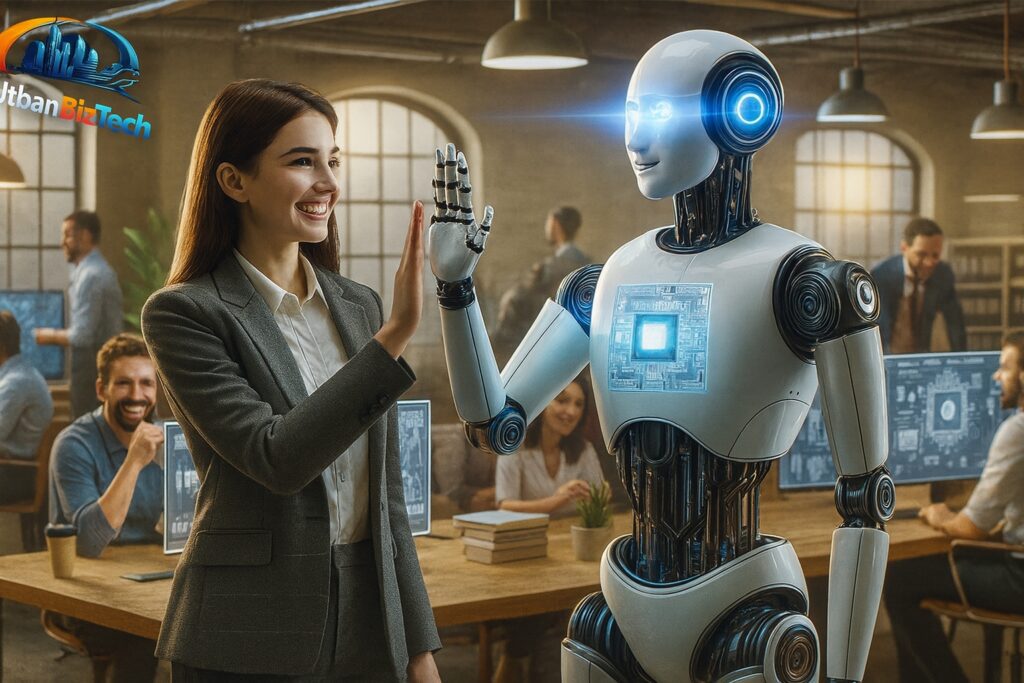
Artificial intelligence is no longer a theoretical concept or a distant future prediction. In 2026, algorithms and intelligent systems have become central to daily decision-making inside companies, from customer service to financial analysis and supply-chain management.
With this acceleration, millions of workers around the world are asking a critical question: Will my job still exist in the coming years?
The answer is more complex than a simple yes or no.
AI doesn’t just eliminate jobs — it reshapes them, changes the skills required, and redefines the value humans bring to the workplace.
In this report, we explore the roles most exposed to decline or transformation, why it is happening, and who stands to win in the new economy.
Why Are Companies Replacing Humans with Intelligent Systems?
From a management perspective, the decision is often economic:
- Lower operating costs
- Higher productivity in less time
- Fewer errors
- 24/7 availability
- Massive data-processing capabilities
When an algorithm can complete a task in seconds with high accuracy, it becomes difficult for organizations to justify repetitive manual labor.
The 10 Jobs Most Exposed to Risk
1) Call Center Employees
AI-powered systems can now understand dialects, analyze tone, and provide immediate solutions. In many industries, the human agent is becoming the exception rather than the rule.
2) Routine Accounting Roles
Modern software can handle bookkeeping, detect anomalies, and generate reports automatically. The human role is gradually shifting from data entry to advisory and decision support.
3) Low-Value Content Production
Basic articles, product descriptions, and fast marketing copy can be generated in minutes. What remains in demand is insight, investigation, and storytelling.
4) Drivers
Advances in autonomous driving are putting increasing pressure on delivery, logistics, and transportation sectors, even if full adoption may still take time.
5) Data Entry Clerks
Few jobs are as perfectly suited for automation: repetitive, rule-based, and predictable.
6) General Translators
AI translation tools are faster and more context-aware than ever. However, legal, literary, and culturally sensitive translation still requires human expertise.
7) Repetitive Factory Labor
Robots don’t get tired, don’t take vacations, and deliver consistent precision, making them attractive long-term investments.
8) Basic Banking Services Staff
Opening accounts, transfers, and initial approvals are increasingly handled through apps and automated systems.
9) Traditional Commercial Photographers
AI-generated imagery has reduced the need for expensive shoots in many advertising and e-commerce scenarios.
10) Junior Legal Analysts
Intelligent systems can review vast volumes of documents in a fraction of the time, reducing the number of entry-level hours required.
But Jobs Don’t Always Die — They Evolve
Economic history shows that technology eliminates tasks while creating new categories of work.
The accountant becomes a strategic advisor.
The translator becomes a localization and cultural expert.
The service agent becomes a customer-experience manager.
Value shifts from execution to thinking.
Where Will New Jobs Grow?
The strongest expansion is happening in areas such as:
- AI system development and engineering
- Advanced data analytics
- Tech ethics and governance
- Cybersecurity
- Digital product management
- Creative direction and brand building
The more a role requires human judgment, empathy, or innovation, the safer it tends to be.
How Do You Protect Your Career?
The market rewards those who adapt quickly.
The most important skills in the AI era include:
- Critical thinking and problem solving
- Technological literacy
- Continuous learning
- Creativity
- Communication and leadership
In simple terms: learn how to work with AI, not against it.
Artificial intelligence is not a passing wave; it is a rewriting of the rules of the game.
Jobs built on repetition are vulnerable, while human value rises wherever vision, judgment, and creativity are required.The future will not belong to the strongest — but to the fastest learners.
FAQ – AI and Jobs: What You Need to Know in 2026
Q1: Will AI completely replace human jobs?
No. While AI will automate routine and repetitive tasks, jobs requiring creativity, judgment, and human interaction will remain in demand. The key is to adapt and focus on skills AI cannot replicate.
Q2: Which jobs are most at risk of disappearing?
Jobs like call center agents, routine accountants, data entry clerks, general translators, and drivers are most exposed. Roles that rely heavily on repetition and predictable tasks are prime targets for automation.
Q3: What skills will help me stay relevant in the AI era?
High-demand skills include:
- Critical thinking and problem-solving
- Creativity and innovation
- Advanced data analysis
- AI and tech literacy (programming, automation)
- Leadership and communication
Focus on areas where humans outperform machines.
Q4: Can AI create new jobs?
Absolutely. AI is generating new opportunities in fields such as:
- AI development and engineering
- Cybersecurity
- Digital product management
- Creative direction and brand strategy
- Data-driven decision making
Q5: How can I future-proof my career against AI?
- Embrace lifelong learning
- Upskill in technology and analytics
- Focus on creative and strategic tasks
- Learn to collaborate with AI tools rather than compete with them
Pingback: Buying AI.com for $70 Million: Why It’s Worth Every Penny and What the New Owner Plans - Urban Business Technology
Pingback: ChatGPT vs Gemini vs Grok vs Perplexity vs Claude in 2026: Which AI Model Is Best for You? - Urban Business Technology
Pingback: How Artificial Intelligence Can Teach Us the Art of True Listening - Urban Business Technology