
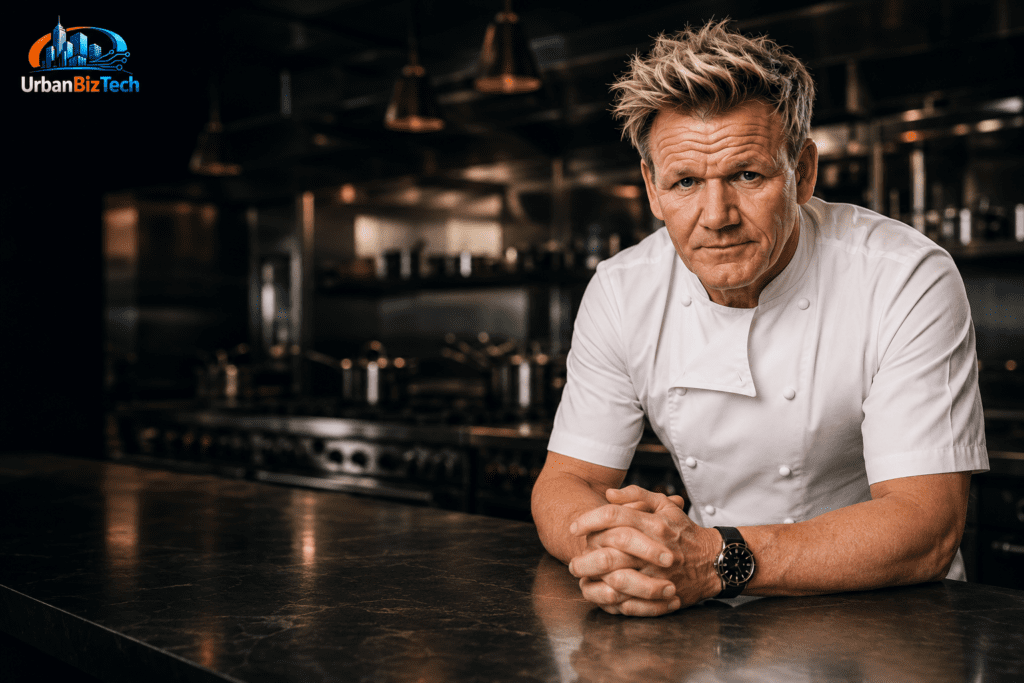

From Michelin-starred kitchens to global television and private-equity partnerships, Gordon Ramsay transformed culinary credibility into one of the world’s most valuable chef-driven brands.
For many consumers, Gordon Ramsay is the fiery television personality behind Hell’s Kitchen, MasterChef, and viral kitchen confrontations. But behind the persona sits a sophisticated business machine — one built on premium dining, intellectual property, media ownership, licensing, and global brand expansion.
Public estimates place Gordon Ramsay’s net worth between $220 million and $250 million as of 2025–2026, positioning him among the wealthiest celebrity chefs globally. While exact financial figures remain private, available business filings, partnership announcements, and industry estimates suggest that Ramsay’s fortune stems less from restaurant margins and more from scalable media economics.
The story of Ramsay’s wealth is not simply about cooking. It is about leverage.
From Failed Football Dreams to Culinary Discipline
Born in Scotland in 1966 and raised in England, Ramsay initially pursued a career in professional football before a knee injury forced him to reconsider his future.
Rather than ending his ambitions, the setback redirected them.
Ramsay entered professional kitchens and trained under some of Europe’s most influential chefs, including Marco Pierre White, Albert Roux, Guy Savoy, and Joël Robuchon. The intensity of those kitchens shaped the precision, discipline, and perfectionism that later became central to both his culinary reputation and media identity.
In retrospect, Ramsay’s early career provided something more valuable than technical expertise: credibility.
That credibility would later become the foundation of a global business empire.
The Michelin-Star Strategy: Reputation Before Scale
In 1998, Ramsay opened Restaurant Gordon Ramsay in Chelsea, London.
Within three years, the restaurant earned three Michelin stars, one of the highest distinctions in fine dining — an achievement it has maintained for more than two decades.
For Ramsay, Michelin recognition did more than establish prestige. It created pricing power and institutional trust.
In luxury industries, reputation often functions as a form of economic capital. Before television audiences viewed Ramsay as an entertainer, the culinary world recognized him as an elite chef.
That distinction mattered.
Celebrity can attract audiences. Credibility sustains premium brands.
Restaurants Built the Brand — But Not the Fortune
Today, Gordon Ramsay Restaurants operates an international portfolio spanning the United Kingdom, North America, Europe, the Middle East, and Asia.
Its concepts range from high-end fine dining to scalable casual formats, including:
- Bread Street Kitchen
- Street Burger
- Street Pizza
- Hell’s Kitchen restaurant concepts in key tourism markets
According to publicly available reporting and company disclosures, the restaurant business has generated tens of millions in annual revenue.
Yet restaurant economics are notoriously difficult.
Profit margins in hospitality frequently remain in the single digits, weighed down by labor, rent, food costs, and operational complexity. Even successful restaurants can struggle to produce outsized returns.
This is where Ramsay diverged from many celebrity chefs.
Restaurants built his authority. Media multiplied it.
Television Became the Real Wealth Engine
If Michelin stars established Ramsay’s reputation, television transformed him into a global asset.
Over two decades, Ramsay evolved from chef to media entrepreneur through a portfolio of internationally syndicated shows, including:
- Hell’s Kitchen
- MasterChef
- MasterChef Junior
- Kitchen Nightmares
- Next Level Chef
- Gordon Ramsay: Uncharted
His programs air across hundreds of international markets, creating recurring revenue streams that extend well beyond traditional hosting fees.
Industry estimates suggest Ramsay earns substantial compensation per episode, though exact figures remain undisclosed.
The broader economic logic is clear.
A restaurant serves hundreds of guests per day.
A television franchise reaches millions.
And unlike hospitality, media businesses offer significantly higher margins and global scalability.
The economics of television fundamentally altered Ramsay’s earning potential.
The Strategic Move Most People Miss: Ownership
The most consequential shift in Ramsay’s career may not have been television fame itself — but ownership.
In partnership with Fox Entertainment, Ramsay launched Studio Ramsay Global, a production company designed to expand his control over content creation and intellectual property.
This structure matters because media ownership changes the economics entirely.
Rather than earning solely as on-screen talent, Ramsay can participate in:
- Production revenue
- International distribution income
- Format licensing
- Long-term syndication value
In modern entertainment, ownership frequently matters more than salary.
Many public figures generate wealth from appearances.
The richest ones own the platform.
Private Equity Accelerated Expansion
In 2019, Ramsay sold a 50% stake in his North American restaurant business to Lion Capital in a deal reportedly valued at approximately $100 million.
The transaction was strategic rather than symbolic.
It provided expansion capital while accelerating Ramsay’s U.S. footprint through new restaurant openings and operational scale.
This reflects a broader pattern among modern celebrity entrepreneurs: using outside capital to grow premium consumer brands without surrendering brand identity.
Instead of relying solely on organic growth, Ramsay leveraged institutional investment to expand faster.
Licensing: The Quiet Profit Center
Beyond restaurants and television, Ramsay monetized his brand through product licensing and endorsements.
Partnerships in cookware, kitchen products, and food-related categories — including his high-profile relationship with HexClad — represent an increasingly important component of his business ecosystem.
Licensing carries a structural advantage over restaurants.
It is capital-light.
Once brand trust exists, products can scale globally without the operational burdens of physical hospitality.
For celebrity entrepreneurs, licensing often becomes one of the highest-margin business segments.
Diversification Protects the Empire
Ramsay’s business portfolio extends beyond kitchens and television.
Like many high-net-worth entrepreneurs, he has reportedly invested in real estate, hospitality ventures, and luxury assets, helping diversify income streams during shifts in media production cycles or consumer spending.
The strategy reflects a broader principle of wealth preservation:
High-income careers generate cash.
Diversified assets preserve it.
Why Gordon Ramsay’s Business Model Works
Ramsay’s success cannot be explained by fame alone.
Many celebrity chefs achieved recognition.
Few built globally scalable businesses.
His advantage lies in the interaction of four reinforcing systems:
1. Culinary Credibility
Michelin-level recognition created trust before mainstream fame.
2. Media Scale
Television turned expertise into mass distribution.
3. Ownership Economics
Production partnerships increased long-term upside.
4. Brand Extension
Licensing and restaurant concepts monetized audience trust across categories.
Together, these created a self-reinforcing ecosystem in which restaurants strengthened television credibility, television amplified brand equity, and brand equity expanded commercial opportunities.
The Bottom Line
Gordon Ramsay did not become wealthy simply by opening restaurants.
He built wealth by transforming culinary expertise into an integrated global brand.
Fine dining established authority.
Television created scale.
Ownership generated leverage.
Licensing improved margins.
And strategic partnerships accelerated growth.
The result is a business empire that extends far beyond the kitchen — and a case study in how expertise, when paired with media and ownership, can evolve into lasting wealth.
FAQ: Gordon Ramsay’s $220M Culinary Empire
1. How much is Gordon Ramsay worth?
Estimates place his net worth between $220 million and $250 million (2025–2026), though exact figures are not public.
2. How did Gordon Ramsay make his money?
His wealth comes from a mix of:
- Restaurants and hospitality businesses
- Television shows and hosting roles
- Production and media ownership
- Brand licensing and product partnerships
- Investments and real estate
3. Is Ramsay richer from restaurants or TV?
Television is generally considered his most profitable business, because it scales globally and has higher margins than restaurants.
4. How important are his restaurants to his wealth?
Restaurants built his credibility and brand reputation, but they are not the main driver of his fortune due to low industry profit margins.
5. What role does Michelin recognition play in his success?
His three-Michelin-star restaurant established elite culinary credibility, which helped justify premium branding and media opportunities later.
6. What is Studio Ramsay Global?
It is his production company with Fox Entertainment, giving him ownership stakes in content creation and distribution, not just on-screen earnings.
7. Why is television so profitable for him?
TV shows like Hell’s Kitchen and MasterChef reach global audiences, generate syndication revenue, and scale far beyond physical restaurants.
8. Does he make money outside restaurants and TV?
Yes, through:
- Kitchenware and cookware licensing (e.g., HexClad partnership)
- Brand endorsements
- Business investments
9. Did private equity play a role in his expansion?
Yes. He sold a 50% stake in his North American restaurant business to Lion Capital, helping fund expansion in the U.S. market.
10. What is the key reason for his financial success?
His success comes from combining:
culinary credibility + media scale + ownership control + brand licensing