
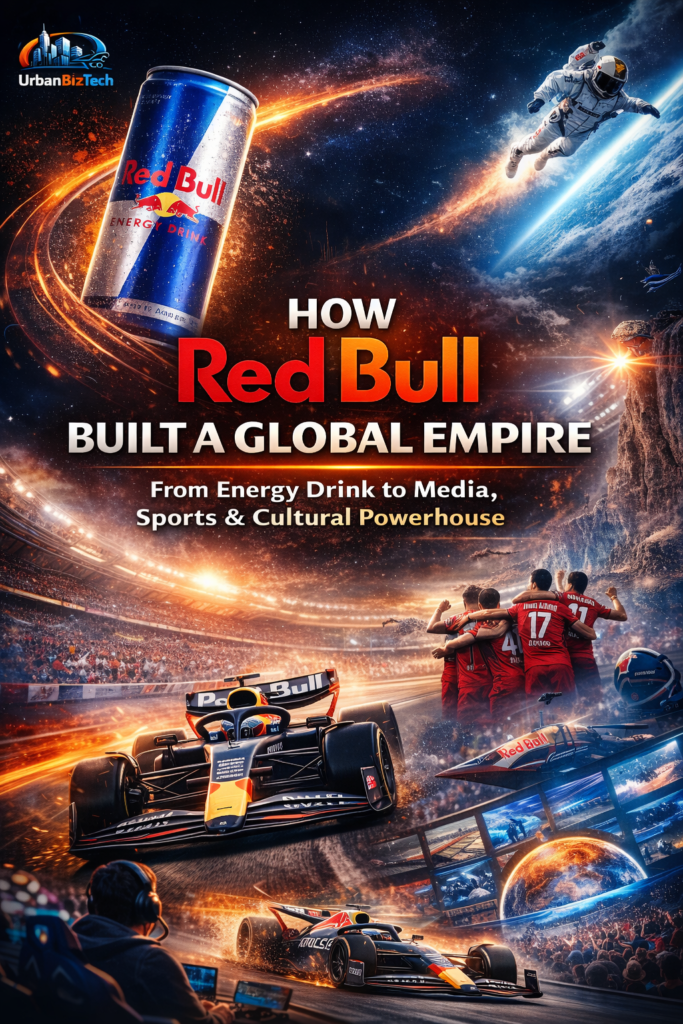
By redefining marketing, owning culture and controlling content, Red Bull didn’t just sell a beverage — it built a self-sustaining global ecosystem.
In a world dominated by beverage giants, few brands have rewritten the rules of growth like Red Bull. What began as a niche energy drink evolved into a vertically integrated empire spanning elite sports, media production, entertainment, technology and youth culture.
This is not the story of a product breakthrough.
It’s the story of strategic positioning, narrative ownership and ecosystem design.
The Origin: From Thailand to Austria — And Into a New Category
Red Bull’s roots trace back to the Thai energy drink Krating Daeng. When Austrian entrepreneur Dietrich Mateschitz discovered the formula in the 1980s, he recognized something the Western market lacked: a functional beverage positioned around stamina and mental alertness.
In 1987, Red Bull launched in Austria — not as a soda competitor, but as a new product category entirely.
It was smaller.
More expensive.
And it tasted unfamiliar.
Yet the brand succeeded because it didn’t compete with cola. It created the global energy drink category.
Instead of battling incumbents, it built its own battlefield.
Selling Identity, Not Liquid
Most beverage brands sell refreshment. Red Bull sells transformation.
From the beginning, the company positioned itself around ambition, adrenaline and pushing human limits. Its slogan, “Red Bull gives you wings,” became less about caffeine — and more about potential.
Inventing Events, Not Sponsoring Them
Rather than merely placing logos on existing competitions, Red Bull engineered original events that embodied its values:
- Red Bull Flugtag
- Red Bull Rampage
- Red Bull Air Race
- Red Bull Cliff Diving
These weren’t marketing activations. They were media properties designed for global distribution.
The events generated spectacle.
The spectacle generated content.
The content reinforced identity.
The identity drove product demand.
A closed loop.
The Media Company Disguised as a Beverage Brand
One of Red Bull’s most decisive strategic moves was the creation of Red Bull Media House.
Instead of buying advertising space, Red Bull became the publisher.
The media arm produces:
- Feature documentaries
- Live sports broadcasts
- Digital-first content
- Print publications
- Long-form branded storytelling
This shift transformed Red Bull from advertiser to media owner — a structural advantage few consumer brands possess.
In today’s attention economy, controlling distribution is more valuable than buying exposure.
Red Bull understood this before most legacy brands.
From Sponsorship to Ownership: Strategic Control of Sport
Red Bull didn’t stop at supporting athletes. It bought teams.
Among its most prominent properties:
- Red Bull Racing (Formula 1)
- Scuderia AlphaTauri
- RB Leipzig
- Red Bull Salzburg
Ownership changes the equation. A sponsor buys visibility. An owner controls the narrative.
In global motorsport, Red Bull Racing became one of the dominant forces in Formula 1 over the past decade, elevating the brand’s credibility across continents.
This is not logo placement.
This is embedded brand architecture.
The Moment That Redefined Brand Bravery
In 2012, Red Bull funded the stratospheric freefall of Felix Baumgartner.
The live-streamed jump from the edge of space shattered viewership records and demonstrated the ultimate alignment between brand promise and human performance.
It wasn’t a campaign.
It was cultural history — powered by a beverage company.
Strategic Lessons: Why Red Bull Scaled While Others Advertised
1. Create a Category, Don’t Enter One
Instead of competing directly with Coca-Cola or PepsiCo, Red Bull defined the global energy drink segment.
Category ownership reduces pricing pressure and elevates brand authority.
2. Build a Content Ecosystem
Traditional brands interrupt attention.
Red Bull earns it.
By producing its own media, it bypasses dependency on external channels. Every event feeds its media arm. Every media asset reinforces brand mythology.
This creates compounding brand equity.
3. Invest in Culture, Not Campaigns
Red Bull embedded itself into:
- Extreme sports
- Urban athletics
- Music and creative scenes
- Esports and gaming
When a brand becomes culturally native, advertising becomes secondary.
4. Control the Narrative at Every Level
From athlete partnerships to team ownership to event production and media distribution, Red Bull operates a vertically integrated branding system.
Few consumer companies achieve that level of control.
The Numbers Behind the Empire
Today, Red Bull sells billions of cans annually across more than 170 countries. Its marketing expenditure consistently ranks among the highest ratios in the beverage industry — yet much of that “marketing” is content production and asset ownership rather than traditional ads.
This distinction matters.
It turns cost centers into long-term equity builders.
Risks and Structural Challenges
No empire scales without exposure to risk:
- Heavy alignment with youth culture and high-risk sports
- Increasing regulatory scrutiny around energy drinks
- Cultural shifts in health consciousness
- Dependence on maintaining relevance in rapidly evolving media ecosystems
However, Red Bull’s diversified model — spanning product, media and owned sports assets — provides resilience many single-category brands lack.
The Strategic Position Today
Red Bull is not in the beverage business alone.
It operates at the intersection of:
- Performance
- Media ownership
- Cultural influence
- Experiential marketing
- Global sport
Its competitive moat is not caffeine.
It is narrative control.
Final Analysis: The Brand as a Self-Sustaining System
Red Bull’s real innovation was not formula-based. It was architectural.
It built:
- A new category
- A proprietary media network
- Owned sports franchises
- A global cultural identity
While most companies rent attention, Red Bull manufactures it.
And in a digital economy driven by engagement, distribution and identity, that may be the most valuable asset of all.
The lesson for modern brands is clear:
If you control the story, you control the market.
Frequently Asked Questions (FAQ) About Red Bull
1) Is Red Bull just an energy drink company?
No. While Red Bull’s core revenue comes from energy drinks, the company operates as a vertically integrated brand ecosystem that includes media production, sports team ownership, live events and cultural programming. Through Red Bull Media House, it functions as a global content producer — not just a beverage brand.
2) Who founded Red Bull?
Red Bull was co-founded by Austrian entrepreneur Dietrich Mateschitz after he discovered the Thai drink Krating Daeng in the 1980s and adapted it for Western markets.
3) How did Red Bull create the energy drink category?
Instead of competing with soda giants, Red Bull positioned itself as a functional performance drink focused on stamina and mental alertness. By defining a new category — energy drinks — it avoided direct price competition with companies like Coca-Cola and PepsiCo.
4) Why does Red Bull own sports teams?
Red Bull moved beyond sponsorship into ownership to gain full control over brand narrative and exposure. It owns teams such as:
- Red Bull Racing
- RB Leipzig
- Red Bull Salzburg
Ownership allows the brand to integrate marketing, storytelling and competitive success under one unified strategy.
5) What is Red Bull Media House?
Red Bull Media House is the company’s in-house media division. It produces documentaries, live sports broadcasts, digital content, magazines and branded storytelling. This structure allows Red Bull to generate its own global distribution instead of relying solely on paid advertising.
6) What was the Felix Baumgartner space jump?
In 2012, Red Bull sponsored Austrian skydiver Felix Baumgartner in a record-breaking stratospheric freefall project known as Red Bull Stratos. The live-streamed event became one of the most watched broadcasts in YouTube history at the time and demonstrated the brand’s commitment to extreme human achievement.
7) How many countries does Red Bull operate in?
Red Bull products are sold in more than 170 countries worldwide, with billions of cans sold annually. Its global footprint spans Europe, North America, Asia-Pacific, Latin America and the Middle East.
8) What makes Red Bull’s marketing strategy unique?
Red Bull focuses on:
- Creating proprietary events instead of traditional sponsorship
- Producing its own media content
- Owning sports teams
- Embedding itself in youth and performance culture
This integrated ecosystem transforms marketing expenses into long-term brand assets.
9) Is Red Bull successful in Formula 1?
Yes. Red Bull Racing has become one of the most dominant teams in modern Formula 1, strengthening Red Bull’s global visibility and credibility in elite motorsport.
10) What is the biggest lesson from Red Bull’s growth?
Red Bull demonstrates that modern brands win by:
- Creating new categories
- Owning content and distribution
- Controlling cultural narratives
- Building ecosystems rather than running campaigns
Its competitive advantage lies not just in product formulation — but in strategic brand architecture.
Pingback: Neymar Net Worth: How Neymar Jr Built a $400 Million Empire