
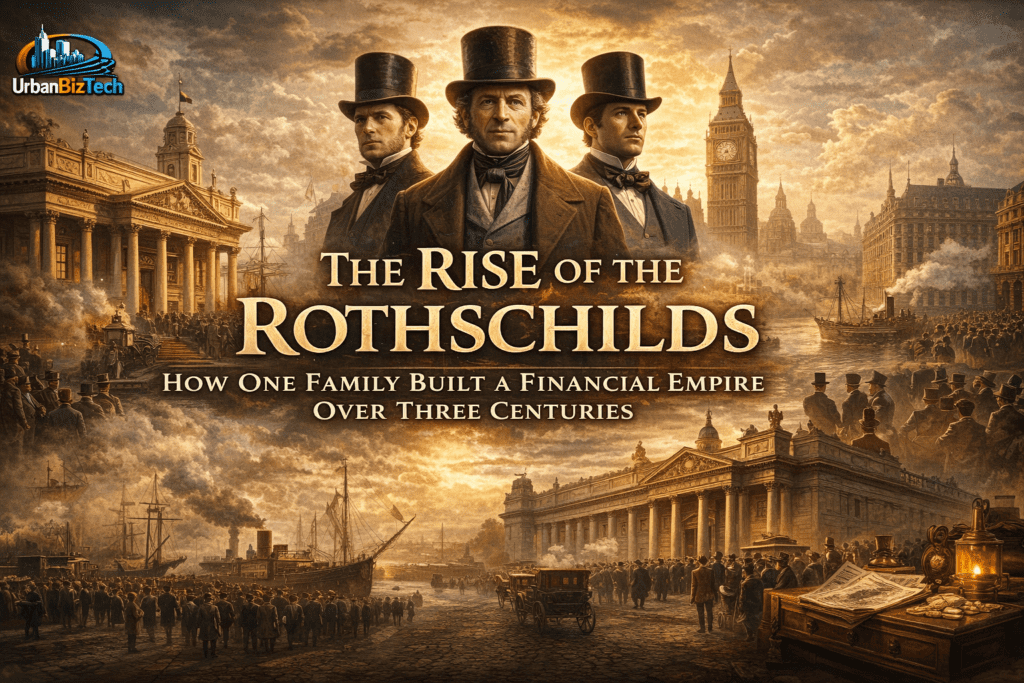
For more than two hundred years, the name Rothschild has carried an aura of wealth, power, and mystery. Historians, economists, and conspiracy theorists alike have debated the scale of the family’s influence on global finance.
The truth is both fascinating and more grounded than the myths suggest.
The dynasty began with a determined merchant in 18th-century Europe and evolved into one of the most influential banking networks the world had ever seen. At its peak, the family financed governments, infrastructure, railways, and major industrial projects across continents.
At the center of the story is Mayer Amschel Rothschild, a businessman whose strategy reshaped international banking.
Origins in 18th-Century Europe
A Childhood in the Frankfurt Ghetto
The Rothschild story begins in Frankfurt in the mid-1700s.
At the time, Jewish families were restricted in many professions and often confined to specific districts. Mayer Amschel grew up in modest circumstances but was exposed early to trade, currencies, and precious metals.
He began his career dealing in rare coins and financial goods, which brought him into contact with wealthy collectors and aristocrats.
One of his most important early clients was a German princely family whose trust helped establish his reputation as a reliable financial agent.
From the beginning, three qualities distinguished him:
- Exceptional financial discipline
- Relationship building with powerful clients
- A long-term strategic vision
These traits laid the groundwork for what would become a banking dynasty.
The Strategy That Changed Banking Forever
The Five Sons Plan
Mayer Amschel understood something revolutionary for his time: finance works best as a network.
Instead of building one bank in one city, he sent his five sons to major European financial centers.
| Son | City | Role |
| Amschel | Frankfurt | Managed the original bank |
| Nathan | London | Built the most powerful branch |
| James | Paris | Expanded influence in France |
| Salomon | Vienna | Connected with the Austrian Empire |
| Carl | Naples | Handled Southern European markets |
These cities—London, Paris, Vienna, and Naples—were among the most important financial and political centers of the era.
By operating as a coordinated family network, the Rothschilds could move capital, information, and credit across borders faster than most governments.
In an age before telephones or electronic banking, this advantage was extraordinary.
Nathan Rothschild and the Power of London
Among the five brothers, Nathan Mayer Rothschild proved the most influential.
Arriving in Britain in the early 19th century, Nathan built what would become the most powerful branch of the family empire.
London was already emerging as the financial heart of global trade. The British Empire’s shipping networks, expanding industry, and growing bond markets created massive opportunities.
Nathan Rothschild excelled in several areas:
- Government bonds
- War financing
- International money transfers
- Commodity trading
His ability to move funds across Europe during the Napoleonic Wars gave Britain access to critical resources.
This made the Rothschild bank indispensable to several governments.
The Information Advantage
One of the family’s greatest innovations was information speed.
Today we take instant communication for granted, but in the early 1800s financial information could take days or weeks to travel.
The Rothschilds built a private intelligence and courier network including:
- Dedicated messengers
- Fast horse routes
- Shipping contacts
- Early signal systems
Because of this network, they often knew political or market developments before competitors.
In finance, timing can mean millions.
For the Rothschilds, it meant dominance.
Financing Governments and Empires
During the 19th century, the family became known as the bankers to Europe.
They financed or helped structure loans for major powers including:
- Britain
- France
- Austria
- Prussia
- Italy
Government borrowing at the time was complex and risky. Wars, revolutions, and unstable currencies created constant uncertainty.
The Rothschilds thrived in this environment because they could distribute risk across their international branches.
Instead of one bank carrying the entire burden of a loan, several family offices could cooperate.
This model was ahead of its time and resembles modern multinational banking.
Railways, Mines, and Infrastructure
As Europe industrialized, enormous capital was required to build new systems.
The Rothschild family invested heavily in:
- Railroads
- Mining operations
- Energy infrastructure
- Metal industries
Railways in particular were the technology revolution of the 1800s.
Just as the internet reshaped the modern world, railroads reshaped 19th-century economies.
Financing them made the Rothschilds extremely influential.
They were not only lenders but sometimes investors and advisors.
The Suez Canal and Global Trade
One of the most famous infrastructure stories of the century involves the Suez Canal project led by Ferdinand de Lesseps.
While the canal itself was primarily a French-Egyptian initiative, the Rothschild network later played an important role in global finance related to it.
In 1875, the British government urgently needed to purchase Egypt’s shares in the canal.
A Rothschild bank arranged the financing quickly—within days—allowing Britain to secure a strategic trade route between Europe and Asia.
The episode demonstrated how fast financial coordination could influence geopolitics.
Family Rules That Protected the Fortune
The Rothschilds were not just bankers; they were meticulous planners.
Several internal rules helped preserve their wealth.
Marriage Within the Family
For generations, marriages between cousins were encouraged.
The goal was to prevent fragmentation of wealth and maintain control over business interests.
Extreme Privacy
Unlike many wealthy families today, the Rothschilds rarely publicized their assets.
This secrecy fueled myths about unimaginable riches, but it also protected them from political pressure.
Regional Responsibility
Each branch specialized in its region while remaining connected to the others.
This allowed both local expertise and international power.
Diversification
The family invested across sectors:
- Banking
- Agriculture
- Wine production
- Real estate
- Mining
- Philanthropy
Diversification helped them survive economic crises.
Challenges in the 20th Century
The two World Wars dramatically reshaped Europe and global finance.
Several of the family’s banks faced nationalization, political upheaval, or economic decline.
In addition:
- Aristocratic influence declined
- New financial institutions emerged
- Governments increased regulation
Despite these pressures, parts of the Rothschild network adapted.
Instead of focusing mainly on sovereign loans, they moved toward:
- investment banking
- mergers and acquisitions
- asset management
- private wealth services
This transition kept the name relevant in modern finance.
The Modern Rothschild Businesses
Today the family does not operate as a single unified financial empire.
Instead, multiple branches and companies exist, the most prominent being Rothschild & Co.
The firm focuses on:
- financial advisory
- asset management
- private banking
- mergers and acquisitions
While powerful, it operates within a highly competitive global financial industry that includes major international banks, investment firms, and sovereign funds.
Myths vs Reality
Few financial families have attracted as many conspiracy theories.
Common myths claim the Rothschilds secretly control global banks, governments, or entire economies.
Serious historians and economists generally reject these ideas.
The reality is more nuanced.
The family was unquestionably one of the most powerful financial dynasties of the 19th century.
However, modern finance is far too large and decentralized for any single family to dominate.
Today’s global markets involve:
- central banks
- multinational corporations
- hedge funds
- sovereign wealth funds
- global institutions
The Rothschild legacy remains important—but it is part of a much bigger system.
Philanthropy and Cultural Influence
Beyond banking, members of the family became known for philanthropy.
They funded projects such as:
- hospitals
- universities
- scientific research
- arts and culture
- environmental initiatives
Many historic buildings, museums, and educational institutions across Europe exist thanks to their support.
This philanthropic tradition continues today through various foundations.
The Enduring Legacy
More than 250 years after Mayer Amschel Rothschild began trading coins in Frankfurt, the family name still carries global recognition.
Their real achievement was not secret domination of the world economy.
It was something arguably more impressive:
They built one of the first truly international financial networks in history.
Their methods—information speed, geographic diversification, risk sharing, and relationship banking—became standard practices in modern finance.
In many ways, the Rothschild story is also the story of how global banking itself was invented.
Frequently Asked Questions About the Rothschild Family
Who founded the Rothschild banking dynasty?
The dynasty was founded by Mayer Amschel Rothschild in the 18th century in Frankfurt.
He started as a coin dealer and financial agent before building a banking network through his five sons across Europe.
Why did the Rothschild family become so powerful?
Several factors contributed to their rise:
- A network of banks across major European capitals
- Fast information systems before modern communications
- Financing governments during wars and economic expansion
- Strategic family coordination between branches
This structure made them one of the most influential banking families of the 19th century.
Which cities were key to the Rothschild network?
The family strategically placed their operations in major financial centers including:
- London
- Paris
- Vienna
- Naples
- Frankfurt
This allowed them to move money, information, and credit across borders faster than competitors.
Did the Rothschilds finance major historical projects?
Yes. Throughout the 19th century the family helped finance railways, mining companies, and government loans.
They were also involved in financial arrangements related to the Suez Canal, a critical global trade route.
Are the Rothschilds still wealthy today?
Yes, but their wealth is spread across many family branches and businesses rather than one centralized fortune.
One of the main modern firms connected to the family is Rothschild & Co, which focuses on financial advisory, asset management, and private banking.
Do the Rothschilds control the global economy?
No credible historical or economic evidence supports this claim.
While the family was extremely influential in 19th-century European finance, today’s global financial system includes thousands of institutions, governments, and corporations.
What industries are associated with the Rothschild family today?
Modern activities include:
- Investment banking
- Wealth management
- Agriculture
- Wine production
- Philanthropy
- Energy and infrastructure investments
Pingback: How Switzerland Became the World’s Largest Wealth Management Hub