
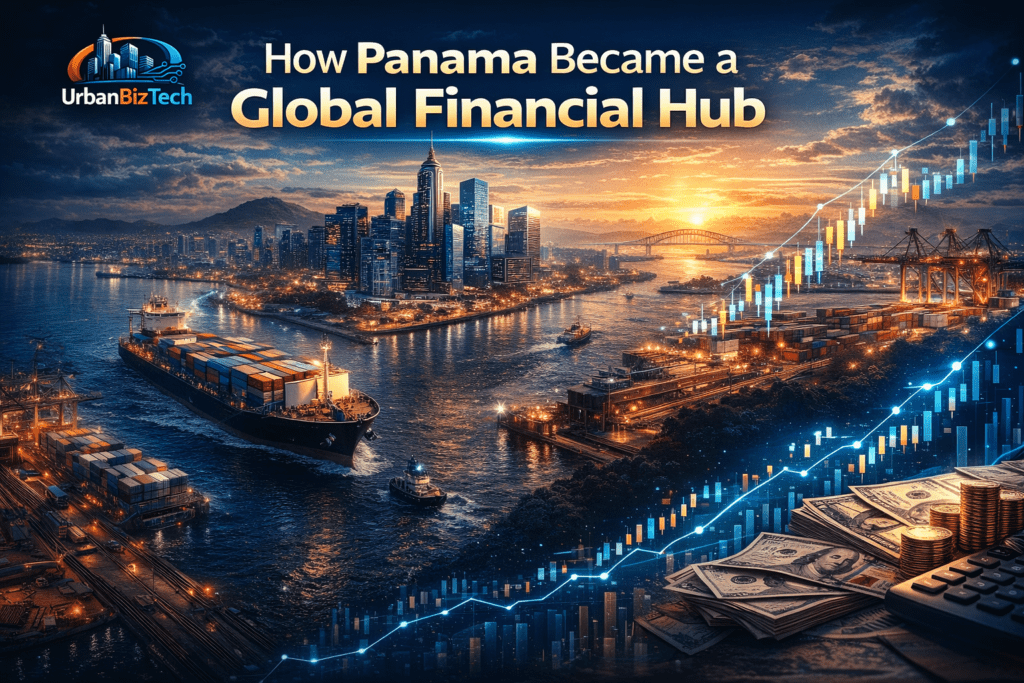
Over the past few decades, Panama has transformed from a small Central American nation into one of the most strategically positioned financial centers in the world. What once was a transit country built around a canal is now a sophisticated financial, logistics, and international banking hub attracting multinational corporations, global banks, and cross-border investors.
This evolution was not accidental. It was engineered—through geography, policy design, financial liberalization, and strategic economic planning.
Geography as Strategy: The Power of the Panama Canal
No discussion of Panama’s financial rise can begin without acknowledging the pivotal role of the Panama Canal.
Connecting the Atlantic and Pacific Oceans, the canal handles roughly 5% of global maritime trade. Its expansion in 2016 significantly increased capacity, allowing larger Neo-Panamax vessels to transit and boosting trade volumes.
But the canal’s impact goes beyond shipping.
It created:
- A logistics ecosystem
- Maritime insurance demand
- Trade financing activity
- Legal and corporate structuring services
- International banking inflows
In short, global trade flows translated into financial flows.
Financial Liberalization: Building an Offshore Banking Magnet
Panama’s financial ascent accelerated in the 1970s when policymakers introduced legislation encouraging international banking operations.
Key strategic decisions included:
- Tax exemptions on foreign-sourced income
- Liberal licensing for foreign banks
- Minimal capital movement restrictions
- Full integration with the U.S. dollar monetary system
Unlike most emerging economies, Panama does not have a central bank and uses the U.S. dollar as legal tender. This eliminates currency risk and enhances investor confidence—an advantage rarely matched in Latin America.
By the 1980s, Panama had become the largest international banking center in the region, hosting branches of major North American and European financial institutions.
Today, more than 80 banks operate within its International Banking Center.
Infrastructure: More Than a Canal Economy
Panama systematically built complementary infrastructure to reinforce its financial ecosystem.
This includes:
- The Colón Free Trade Zone (one of the largest in the world)
- Modern ports on both coasts
- Tocumen International Airport as a regional aviation hub
- Advanced telecom and fiber-optic connectivity
These assets strengthened Panama’s position as a regional headquarters destination for multinational corporations operating in Latin America.
Transparency Reforms: From Controversy to Compliance
Panama’s reputation faced serious scrutiny following the 2016 leak commonly known as the Panama Papers.
The revelations intensified global pressure regarding tax transparency and anti-money laundering standards.
In response, Panama implemented sweeping reforms:
- Alignment with the standards of the Financial Action Task Force
- Automatic exchange of financial information agreements
- Strengthened AML and KYC regulations
- Enhanced regulatory supervision of financial institutions
While challenges remain, Panama has steadily repositioned itself as a more compliant and internationally integrated financial jurisdiction.
For investors, this shift from opacity to structured regulation has reduced reputational risk while maintaining structural tax advantages.
Competitive Position: Can Panama Rival Global Financial Capitals?
Panama is not Singapore. Nor is it Zurich.
But it plays a different strategic game.
Compared with:
- Singapore
- Zurich
- Miami
Panama offers:
- Dollarized stability
- Lower operational costs
- Strategic proximity to both Americas
- A strong logistics-finance integration model
Its competitive edge lies not in asset management dominance but in trade finance, corporate structuring, regional headquarters operations, and cross-border banking.
Economic Diversification: Beyond Banking
While financial services and logistics remain central, Panama has diversified into:
- FinTech
- Maritime services
- Regional corporate services
- Aviation logistics
- Real estate development
This diversification has increased economic resilience and reduced dependency on canal revenues alone.
Risks and Structural Challenges
No serious financial analysis is complete without examining the risks.
Panama faces:
- Sensitivity to global trade slowdowns
- Exposure to external capital flows
- Continued scrutiny from international regulators
- Reputational legacy from offshore structures
Moreover, as global tax transparency standards tighten, Panama must continuously adapt to remain competitive without sacrificing compliance.
Why Panama Matters in the Global Financial System
Panama represents a unique model of financial statecraft:
A country that leveraged geography into logistics power, logistics into financial intermediation, and financial intermediation into regional influence.
Its success rests on five pillars:
- Strategic geography
- Dollarized stability
- Financial liberalization
- Infrastructure integration
- Regulatory evolution
Today, Panama stands as Latin America’s most structurally integrated financial and logistics hub—serving as a bridge between continents, currencies, and capital flows.
For investors looking at emerging-market financial gateways, Panama is not just a canal economy.
It is a system—designed for capital mobility.
Frequently Asked Questions (FAQ)
1. Why is Panama considered a global financial hub?
Panama is considered a global financial hub because of its strategic geographic location, dollarized economy, liberal banking laws, and the global trade ecosystem built around the Panama Canal. The country has positioned itself as a bridge between North and South America while facilitating international banking and cross-border capital flows.
2. How does the Panama Canal influence Panama’s financial sector?
The Panama Canal drives global trade between the Atlantic and Pacific Oceans. This generates demand for trade finance, maritime insurance, logistics services, and international banking. The canal’s expansion in 2016 significantly increased shipping capacity, further strengthening Panama’s role in global commerce and finance.
3. Does Panama use its own currency?
No. Panama uses the U.S. dollar as legal tender. This dollarized system eliminates currency exchange risk and increases financial stability, making the country attractive to foreign investors and international banks.
4. How many banks operate in Panama?
Panama’s International Banking Center hosts more than 80 local and international banks. These institutions provide services ranging from corporate banking and trade finance to wealth management and regional headquarters support.
5. Is Panama still considered a tax haven?
Panama has historically been associated with offshore finance. However, following global scrutiny after the Panama Papers, the country implemented reforms aligned with standards set by the Financial Action Task Force. While it still offers territorial taxation benefits, regulatory oversight and transparency measures have increased significantly.
6. How does Panama compare to Singapore or Zurich?
Unlike major global wealth management centers such as Singapore or Zurich, Panama focuses more on trade finance, logistics integration, and regional corporate structuring. Its competitive advantage lies in cost efficiency, dollar stability, and geographic positioning.
7. What are the main industries supporting Panama’s financial growth?
Panama’s financial sector is supported by:
- Maritime trade and logistics
- International banking
- Free trade zones
- Aviation and regional headquarters operations
- Emerging financial technology (FinTech)
This diversification reduces reliance on canal revenues alone.
8. What are the risks of investing in Panama’s financial sector?
Key risks include:
- Exposure to global trade cycles
- External regulatory pressure
- Dependence on capital inflows
- Reputational sensitivity linked to offshore finance
However, ongoing reforms and infrastructure investments aim to strengthen long-term resilience.
Pingback: Liechtenstein Financial Center Explained: Banking, Tax System, Wealth Management & EEA Advantage
Pingback: How Singapore Became Asia’s Top Wealth Hub | Family Office & Asset Management Growth
Pingback: Top 15 Offshore Jurisdictions in 2026: The Best Countries for Global Company Formation