
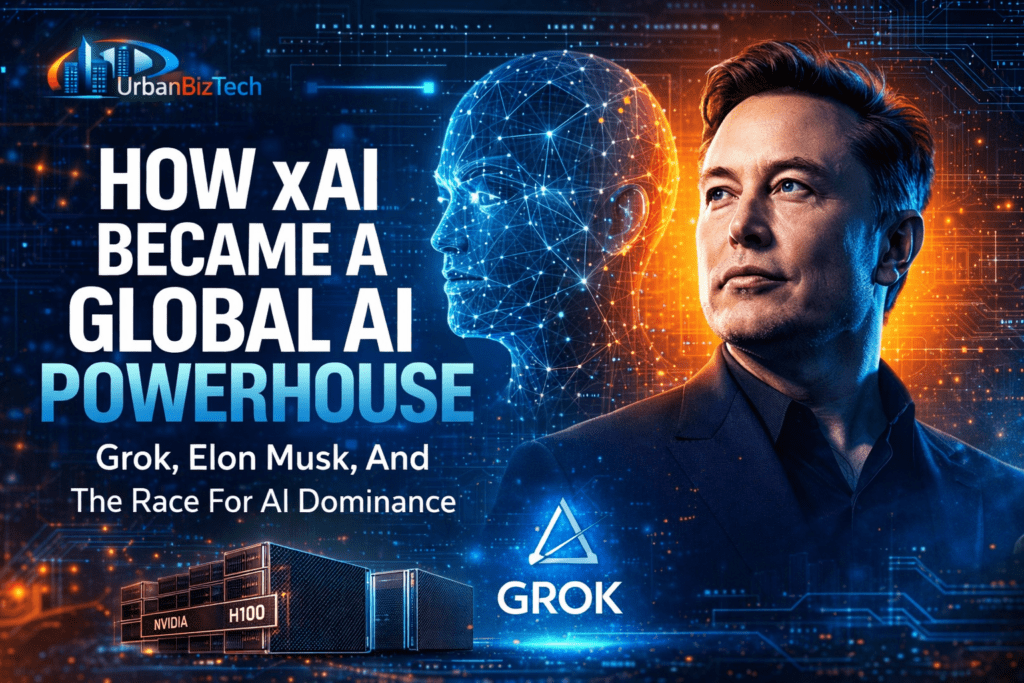
The Rise of a Disruptor in a Market Dominated by Giants
In an industry long dominated by heavyweights like OpenAI, Google DeepMind, and Anthropic, few expected a newly launched startup to break into the upper ranks of the global AI race so quickly.
Yet in less than two years, xAI has evolved from an ambitious vision into a formidable competitor—reshaping conversations around artificial intelligence, data access, transparency, and competitive strategy.
This is not just another AI startup story. It is the blueprint of how capital, compute power, distribution, and brand leverage can compress a decade of growth into a fraction of the time.
Elon Musk’s Strategic Bet on “Truth-Seeking AI”
At the center of xAI’s rapid ascent stands Elon Musk—a founder known for redefining industries through companies like Tesla and SpaceX.
Musk positioned xAI around a provocative and marketable thesis: building a “truth-seeking AI.”
In an era marked by mounting scrutiny over AI bias, censorship concerns, and opaque model training practices, this narrative resonated deeply with both developers and the broader public.
Whether philosophical positioning or calculated branding, the strategy worked. xAI entered the market not as a follower—but as a challenger with ideological differentiation.
Grok: The Product That Changed the Conversation
The turning point came with the launch of Grok.
Unlike competitors operating in relative data silos, Grok was integrated directly into X (formerly Twitter), giving it access to real-time global discourse.
This integration unlocked several competitive advantages:
- Real-time awareness of breaking events
- Direct access to large-scale conversational data
- Built-in distribution to millions of users
- Continuous live feedback loops
While competitors focused on enterprise contracts and API monetization, xAI leveraged distribution—one of Silicon Valley’s most underestimated strategic assets.
Grok’s successive iterations accelerated quickly, with improvements in reasoning, contextual understanding, and long-form analysis—placing it in direct competition with GPT-class and Claude-class systems.
The Compute Advantage: Infrastructure as a Weapon
Artificial intelligence at scale is ultimately a function of compute.
xAI invested heavily in advanced GPU clusters, reportedly powered by NVIDIA’s H100 architecture. In a market where training large frontier models requires enormous capital expenditure, infrastructure is no longer support—it is strategy.
This aggressive investment allowed xAI to:
- Train large-scale models rapidly
- Iterate at high speed
- Compete with established AI labs
- Maintain performance parity in benchmark testing
In the AI arms race, compute is currency. And xAI spent aggressively.
Vertical Integration: The X Ecosystem Effect
Few AI companies enjoy native integration with a global social platform.
By embedding Grok directly into X, xAI created an ecosystem play—blending media, data, AI interaction, and distribution into a single loop.
This vertical integration delivers:
- Real-time training signals
- Behavioral data insights
- Immediate user testing at scale
- Monetization pathways through subscriptions
While OpenAI partners with platforms and Google embeds Gemini into its products, xAI owns its distribution channel outright.
That strategic alignment could prove decisive over time.
Talent Density: Recruiting From the Elite Labs
Beyond branding and infrastructure, xAI assembled a team drawn from some of the most respected AI research environments in the world.
Former contributors from DeepMind, OpenAI, Google Brain, and Tesla AI joined the initiative—creating a high-density concentration of frontier-model expertise.
In advanced AI development, talent asymmetry compounds quickly. And xAI understood this from day one.
Funding and Valuation: The Financial Engine
Frontier AI is capital-intensive. xAI secured multibillion-dollar backing, enabling:
- Rapid infrastructure scaling
- Aggressive hiring
- Model expansion
- Competitive positioning against better-established firms
In today’s AI landscape, financial backing determines survival. Without capital, compute stalls. Without compute, innovation slows.
xAI avoided that bottleneck.
The Competitive Landscape: Threat or Sustainable Challenger?
Despite its momentum, xAI operates in one of the most competitive technology arenas in history.
OpenAI continues expanding enterprise partnerships.
Google DeepMind benefits from Google’s vast ecosystem.
Anthropic positions itself as the AI safety leader.
xAI’s differentiator lies in:
- Distribution ownership
- Brand influence via Musk
- Real-time data integration
- A less restrictive product philosophy
Whether this translates into long-term dominance remains an open question—but the company has already altered competitive dynamics.
Risks and Strategic Questions
No AI contender operates without risk.
xAI faces:
- Regulatory scrutiny in the U.S. and Europe
- Content moderation controversies
- Heavy infrastructure costs
- Market saturation pressures
- Intensifying competition in enterprise AI
The sustainability of its growth will depend on monetization models, enterprise adoption, and continued technical parity with frontier systems.
The Road Ahead: 2027 and Beyond
Looking forward, several strategic paths emerge:
- Larger multimodal AI systems
- Integration across Musk’s broader ecosystem
- Enterprise AI expansion
- AI-driven media transformation
- Robotics and embodied AI convergence
If xAI successfully integrates AI across multiple product layers—social, mobility, automation—it could evolve beyond a standalone lab into a vertically integrated AI conglomerate.
A Startup That Compressed the Timeline
xAI is not merely another AI startup riding a trend cycle. It is an example of accelerated industrial strategy—where brand leverage, capital access, compute infrastructure, and distribution converge simultaneously.
In less than two years, it forced incumbents to respond.
Whether it becomes a dominant force or a powerful niche competitor will depend on execution. But one fact is already clear:
xAI has secured its place in the global AI conversation—and it did so faster than almost anyone predicted.
Frequently Asked Questions (FAQ)
1. What is xAI and who founded it?
xAI is an artificial intelligence company founded in 2023 by Elon Musk. The company was created with the stated mission of building advanced AI systems designed to pursue truth and provide less constrained, more transparent responses compared to traditional AI platforms.
2. How is xAI different from OpenAI and Google DeepMind?
Unlike OpenAI and Google DeepMind, xAI benefits from direct integration with X, giving it access to real-time global data and built-in distribution. This ecosystem advantage allows xAI’s models to analyze live conversations and trends, providing timely contextual awareness that competitors may lack.
3. What is Grok?
Grok is xAI’s flagship AI model and conversational assistant. It is embedded within the X platform and designed to provide real-time analysis, contextual reasoning, and conversational responses. Grok competes directly with leading AI systems such as GPT-based models, Claude, and Gemini.
4. Does xAI use real-time data from X?
Yes. One of xAI’s key competitive advantages is its ability to leverage live data streams from X. This enables its AI models to interpret breaking news, social trends, and public discourse in real time, enhancing situational awareness and responsiveness.
5. What infrastructure powers xAI’s models?
xAI relies on large-scale GPU clusters, including advanced NVIDIA H100 systems, to train and deploy frontier AI models. High-performance computing infrastructure is critical for scaling large language models and competing with major AI labs.
6. Is xAI focused on AI safety?
xAI positions itself around a “truth-seeking AI” philosophy. While it emphasizes transparency and reduced restrictions compared to some competitors, discussions around AI safety, moderation, and regulatory compliance remain central to its long-term strategy.
7. How is xAI funded?
xAI has secured multi-billion-dollar funding to accelerate infrastructure expansion, research, and product development. Significant capital investment is essential in the AI industry due to high compute and research costs.
8. Can xAI compete long-term with major AI companies?
xAI’s long-term competitiveness will depend on sustained technical performance, monetization strategy, regulatory compliance, and enterprise adoption. Its integration with X and backing by Elon Musk provide strategic advantages, but competition in frontier AI remains intense.
9. What industries could xAI impact in the future?
Beyond conversational AI, xAI may expand into areas such as enterprise automation, AI-driven media analysis, robotics, and multimodal AI systems. Integration across Musk-led ecosystems could further amplify its reach.
10. Is xAI considered a major player in the global AI race?
Although relatively new, xAI has rapidly positioned itself among influential AI developers. Its infrastructure investments, product releases, and strategic ecosystem integration have made it a serious contender in the global AI landscape.
Pingback: Will Elon Musk Become the First Trillionaire? Net Worth, Companies, and Future Outlook (2026) - Urban Business Technology
Pingback: ChatGPT vs Gemini vs Grok vs Perplexity vs Claude in 2026: Which AI Model Is Best for You? - Urban Business Technology