
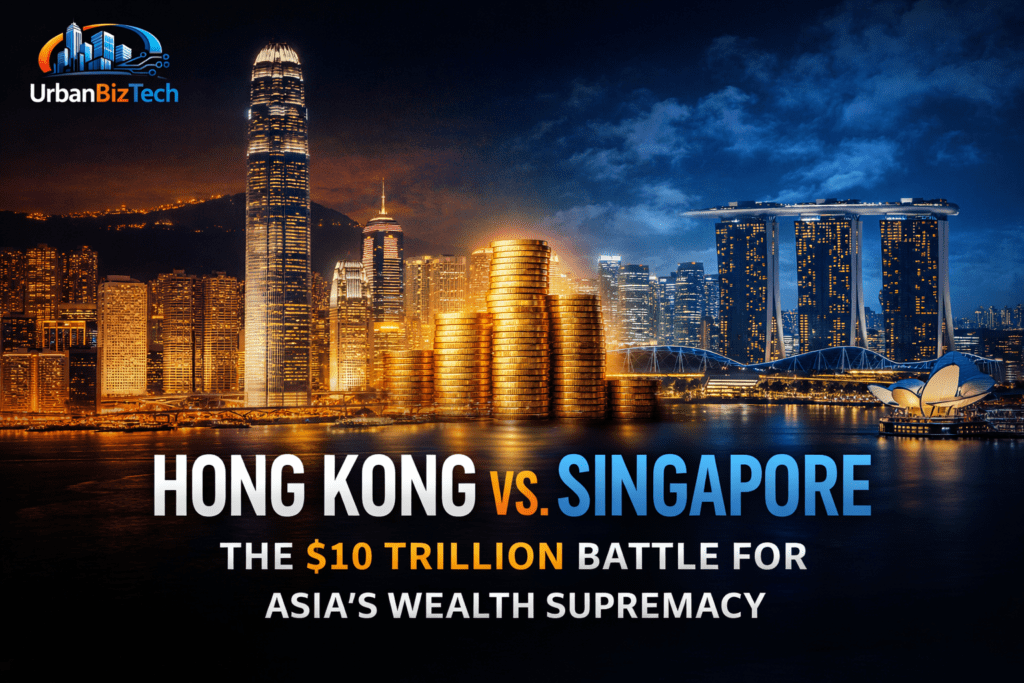
The War for Asia’s Private Capital Is No Longer Quiet
Over the past two decades, Asia has transformed from a capital recipient into a capital powerhouse. Trillions of dollars in private wealth are shifting eastward, driven by first-generation billionaires, expanding family conglomerates, and cross-border investment flows.
At the center of this transformation stand two financial titans: Hong Kong and Singapore.
Both cities are competing to become Asia’s undisputed capital of wealth management, family offices, and private banking. And increasingly, global ultra-high-net-worth families are structuring their wealth strategies around one—or both—of them.
This is not just a regional rivalry. It is a strategic battle for control over Asia’s next $10 trillion in managed wealth.
Why Asia Is Becoming the World’s Wealth Epicenter
Asia is now home to one of the fastest-growing populations of high-net-worth individuals (HNWIs). According to global wealth research from firms like UBS and Capgemini, the region continues to outpace Europe in billionaire creation and intergenerational wealth transfers.
Key drivers include:
- Rapid billionaire growth in China, India, and Southeast Asia
- Global expansion of Asian family-owned conglomerates
- Increasing demand for institutional-grade wealth structuring
- Succession planning across first- and second-generation wealth
The result: an unprecedented surge in family office formations across Asia.
And nearly all roads lead to either Hong Kong or Singapore.
Assets Under Management: A Multi-Trillion Dollar Contest
Both jurisdictions manage trillions in assets.
- Singapore oversees approximately SGD 5.4 trillion in assets under management (2021 figures).
- Hong Kong manages roughly USD 4.55 trillion in assets under management (2021).
While headline numbers appear comparable, the strategic composition differs:
- Singapore’s growth is driven by diversified global capital inflows.
- Hong Kong’s flows are deeply integrated with mainland China’s capital markets.
The distinction matters. One is globally diversified; the other is strategically positioned at the gateway of the world’s second-largest economy.
Family Offices: The Fastest-Growing Segment
The explosion of family offices has become the defining trend in Asian wealth management.
Singapore
Singapore has aggressively positioned itself as Asia’s family office capital, with roughly 700 registered family offices as of 2022. Through tax incentive schemes such as Sections 13O and 13U, authorities provide substantial tax exemptions for qualifying structures.
Its advantages:
- Political stability
- Strong regulatory credibility
- Transparent governance
- Neutral geopolitical positioning
Singapore markets itself as the safe, globally trusted vault for long-term capital preservation.
Hong Kong
Hong Kong reports approximately 400 officially registered family offices, though broader estimates suggest as many as 2,700 single-family offices operate within the jurisdiction.
Its key strengths:
- Direct proximity to mainland China
- Access to deep capital markets
- Integration with the Greater Bay Area initiative
- Dominance in Chinese IPO pipelines
For Chinese ultra-high-net-worth families, Hong Kong is not merely an option—it is the financial bridge to global markets.
Regulation and Legal Architecture
Both operate under common law systems. But perception and positioning differ.
Singapore
Singapore has built a reputation for:
- Regulatory discipline
- Strict compliance standards
- Pro-business taxation
- Low corruption risk
Its Monetary Authority functions with centralized efficiency and long-term policy clarity.
Hong Kong
Hong Kong offers:
- A simple, low-tax regime
- No capital gains tax
- Deep financial market liquidity
- Strong banking infrastructure
However, its close integration with China introduces geopolitical considerations that some global investors weigh carefully.
Market Access: The China Factor
This is where the rivalry becomes strategic.
Hong Kong is widely recognized as China’s financial gateway. It dominates offshore RMB liquidity and remains a key listing hub for Chinese corporations.
Singapore, by contrast, serves as Southeast Asia’s headquarters for multinational corporations and global investment funds.
In short:
- Hong Kong connects you to China.
- Singapore connects you to the world.
Investor Preferences Are Shifting
Recent surveys by industry associations and advisory firms show renewed confidence in Hong Kong among global private banks. Nearly half of surveyed institutions now identify Hong Kong as a preferred Asian wealth hub—an increase from previous years.
This suggests that despite geopolitical noise, capital remains pragmatic. Where opportunity exists, money flows.
The Risk Equation
No serious wealth strategy ignores risk.
Risks in Hong Kong
- Heavy dependence on China’s economic cycle
- Geopolitical tensions between China and Western economies
- Perception-related volatility
Risks in Singapore
- Rising operational costs
- Increasing regulatory scrutiny
- Growing competition among wealth managers
The reality? Neither jurisdiction is risk-free. But each offers distinct risk-return profiles.
The Emerging Hybrid Strategy
Increasingly, ultra-wealthy families are not choosing between Hong Kong and Singapore.
They are using both.
- Singapore for global asset structuring and long-term wealth preservation.
- Hong Kong for China-facing investments and capital market access.
This dual-hub strategy reflects a sophisticated understanding of Asia’s financial geography.
Outlook 2026–2030: Who Wins?
Asia’s private wealth is projected to expand significantly over the next decade. The region could become the dominant global center of private capital management.
Hong Kong’s future hinges on:
- Continued integration with China’s financial liberalization
- IPO market strength
- Capital flow stability
Singapore’s trajectory depends on:
- Maintaining regulatory credibility
- Expanding tax-efficient frameworks
- Attracting global family capital beyond Asia
The outcome may not produce a single winner.
Instead, Asia’s wealth future may be defined by a financial duopoly—two cities operating as complementary pillars of a new global capital order.
If you seek:
- Political neutrality, global diversification, and institutional stability → Singapore
- China exposure, capital market depth, and IPO connectivity → Hong Kong
For the world’s most sophisticated families, the answer is increasingly strategic rather than binary.
In the $10 trillion battle for Asia’s wealth empire, the real winner may be those who understand how to leverage both.
Frequently Asked Questions (FAQ)
1. Which is better for wealth management: Hong Kong or Singapore?
There is no universal winner.
- Singapore is often preferred for political stability, regulatory clarity, and tax-efficient family office structures.
- Hong Kong is favored for China market access, IPO connectivity, and deep capital markets.
Many ultra-high-net-worth families now use both jurisdictions strategically.
2. Why is Singapore attracting so many family offices?
Singapore offers strong tax incentives under schemes such as 13O and 13U, combined with:
- Transparent governance
- Low corruption risk
- Strong legal protection under common law
- A reputation for long-term political stability
These factors make it attractive for intergenerational wealth preservation.
3. Why is Hong Kong considered the gateway to China?
Hong Kong plays a critical role in connecting mainland China to global capital markets. It provides:
- Offshore RMB liquidity
- Access to Chinese IPOs
- Integration with the Greater Bay Area
- A familiar legal framework for international investors
For investors seeking direct exposure to China, Hong Kong remains a strategic hub.
4. How much wealth is managed in Singapore and Hong Kong?
Recent figures show:
- Singapore manages approximately SGD 5.4 trillion in assets under management.
- Hong Kong manages roughly USD 4.55 trillion in assets under management.
Both rank among the largest wealth management centers globally.
5. Is Singapore safer than Hong Kong for long-term wealth protection?
Singapore is generally perceived as more politically neutral and globally diversified, which appeals to investors seeking long-term stability.
Hong Kong, while stable financially, is more closely linked to China’s economic and geopolitical environment. Risk tolerance and investment strategy often determine the preferred jurisdiction.
6. Do family offices choose between Hong Kong and Singapore — or use both?
Increasingly, wealthy families adopt a dual-hub strategy:
- Singapore for global asset structuring and tax efficiency
- Hong Kong for China-facing investments and capital market access
This approach allows diversification across regulatory and geopolitical frameworks.
7. Which city is growing faster in wealth management?
Singapore has shown steady growth driven by international capital inflows.
Hong Kong’s growth is closely tied to China’s capital markets and cross-border investment activity. When China’s markets expand, Hong Kong typically accelerates rapidly.
8. What are the main risks of each jurisdiction?
Hong Kong risks:
- Dependence on China’s economy
- Geopolitical tensions
Singapore risks:
- Rising operating costs
- Increasing regulatory scrutiny
Neither jurisdiction is risk-free, but both remain among the most stable financial centers in Asia.
Pingback: How Hong Kong Became a Global Financial Center: History, Strategy & Future Outlook
Pingback: How Singapore Became Asia’s Top Wealth Hub | Family Office & Asset Management Growth