
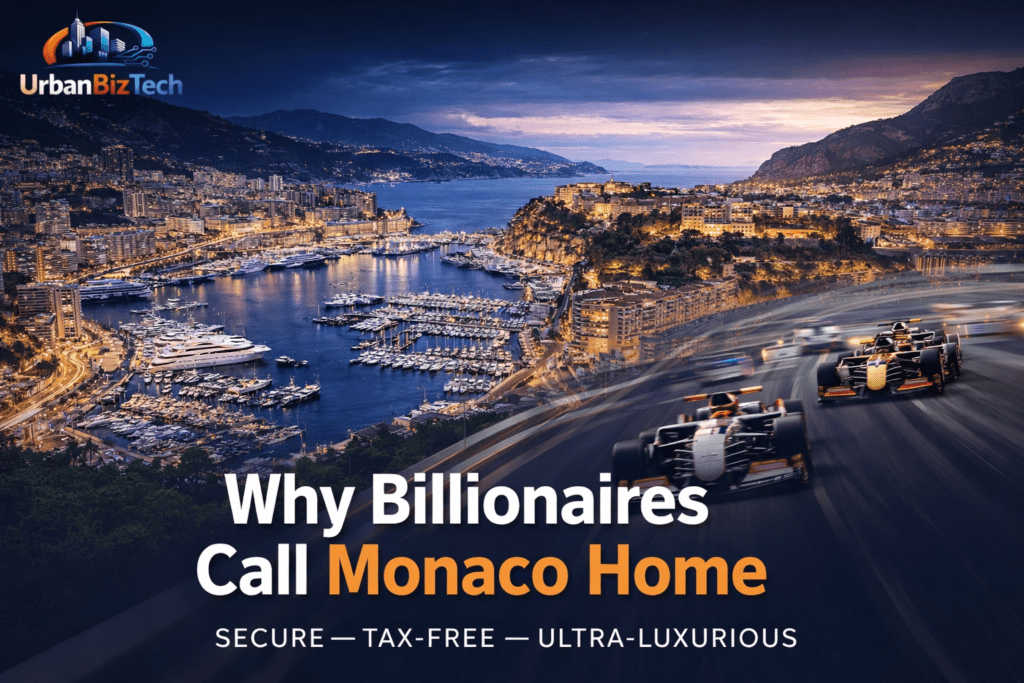
On just two square kilometers of Mediterranean coastline, Monaco has built one of the most powerful wealth brands in modern economic history.
It is not simply a tax haven. It is not merely a luxury destination. Monaco is a carefully engineered ecosystem designed to attract, protect and amplify global wealth.
Today, more than a third of its residents are millionaires — the highest density of wealth anywhere in the world. The question is not why Monaco is rich. The real question is: how did it design a system that keeps the world’s richest people coming?
1. The Tax Strategy That Changed Everything
Monaco abolished personal income tax in 1869 — a radical move at the time. More than a century later, that decision remains the foundation of its economic magnetism.
Residents benefit from:
- No personal income tax
- No wealth tax
- No capital gains tax
- Competitive corporate taxation (with specific conditions)
But here is the nuance: Monaco operates within European financial transparency standards. It cooperates with international tax authorities and has aligned itself with global compliance frameworks. This balance — low taxation without secrecy — is what makes it sustainable.
Unlike aggressive offshore jurisdictions, Monaco positioned itself as a legitimate luxury domicile, not a hidden vault.
2. Extreme Security As A Luxury Product
Monaco has one of the highest police-to-resident ratios in the world. Advanced surveillance systems cover nearly the entire principality.
For ultra-high-net-worth individuals, security is not optional — it is essential. In Monaco, discretion and protection are embedded into daily life.
This is not accidental. It is policy.
3. Real Estate: The World’s Most Expensive Per Square Meter
Prime real estate in Monaco regularly exceeds €50,000 per square meter, making it one of the most expensive property markets on Earth.
Scarcity drives value. With virtually no land available, supply remains permanently constrained. Developments such as Mareterra — the land reclamation expansion — illustrate how the principality engineers growth despite geographical limits.
Owning property here is not just housing. It is status, liquidity preservation, and geographic insurance.
4. The Power Of Global Visibility
Every year, Monaco becomes the epicenter of global elite networking during the Monaco Grand Prix.
The event is more than a race. It is a financial summit disguised as sport — where investors, celebrities, billionaires and policymakers intersect.
Add to that:
- Monaco Yacht Show
- Michelin-starred restaurants
- Five-star hospitality
- Mediterranean climate
The principality turns lifestyle into economic infrastructure.
5. Financial Infrastructure Built For Wealth Preservation
Despite its size, Monaco hosts a sophisticated private banking sector specializing in:
- Wealth management
- Cross-border structuring
- Family office services
- International asset diversification
Its proximity to France and access to the eurozone enhance credibility while maintaining sovereign autonomy.
6. Political Stability: The Quiet Advantage
The long-standing rule of the House of Grimaldi has provided continuity rarely seen in modern governance.
Policy direction is clear: protect capital, ensure stability, maintain prestige.
Monaco does not chase growth. It curates it.
The Challenges Ahead
Yet Monaco is not immune to global shifts:
- Increased EU scrutiny on tax regimes
- Global minimum tax initiatives
- Rising real estate saturation
- Climate-related coastal risks
The principality’s future will depend on how it balances exclusivity with regulatory evolution.
Why Monaco’s Model Still Works
Monaco’s success lies in integration.
Low taxation alone does not create a magnet for billionaires.
Security alone is insufficient.
Luxury alone fades.
But when tax efficiency, safety, prestige, political stability and scarcity converge in one place — wealth follows.
Monaco is not just a destination.
It is a strategy.
Frequently Asked Questions (FAQ)
1. Why do so many millionaires live in Monaco?
Monaco attracts millionaires primarily because it has no personal income tax, offers exceptional security, and provides a stable political environment. Its luxury lifestyle, exclusive real estate market, and global reputation also make it highly attractive to ultra-high-net-worth individuals.
2. Does Monaco really have zero income tax?
Yes. Monaco abolished personal income tax in 1869. Residents generally do not pay income tax, capital gains tax, or wealth tax. However, French citizens living in Monaco are subject to specific tax agreements with France.
3. Is Monaco considered a tax haven?
Monaco is often described as a tax-friendly jurisdiction rather than a secretive tax haven. It complies with international transparency standards and cooperates with global financial authorities while maintaining low personal taxation.
4. How expensive is real estate in Monaco?
Monaco has one of the highest property prices in the world. Prime real estate often exceeds €50,000 per square meter, driven by limited land supply and strong global demand.
5. Is Monaco safe for wealthy residents?
Yes. Monaco is considered one of the safest places in the world. It has one of the highest police-to-resident ratios globally and extensive surveillance coverage, making security a key advantage for wealthy residents.
6. How do you become a resident of Monaco?
To obtain residency in Monaco, applicants typically must:
- Secure accommodation (owned or rented property)
- Demonstrate sufficient financial resources
- Open a local bank account
- Pass background checks
Residency does not automatically grant citizenship.
7. What makes Monaco different from Switzerland or Singapore?
Unlike Switzerland or Singapore, Monaco combines:
- Zero personal income tax
- Mediterranean climate
- Ultra-dense millionaire population
- Compact luxury living
Its scale and exclusivity create a uniquely concentrated wealth ecosystem.
8. What major global events take place in Monaco?
Monaco hosts prestigious international events such as the Monaco Grand Prix and the Monaco Yacht Show. These events attract billionaires, investors, celebrities, and global media every year.
9. Who governs Monaco?
Monaco is a constitutional monarchy ruled by the House of Grimaldi. The principality has maintained political stability for centuries, which contributes significantly to investor confidence.
10. Why is Monaco called a playground for billionaires?
Because it combines tax efficiency, extreme security, luxury infrastructure, political stability, and one of the world’s most exclusive real estate markets — all within just two square kilometers.
Pingback: How Did UBS Become the World’s Largest Wealth Manager? Strategy, AUM & Credit Suisse Deal
Pingback: Monaco vs Dubai in 2026: Taxes, Wealth, Lifestyle & Where the Rich Are Moving