
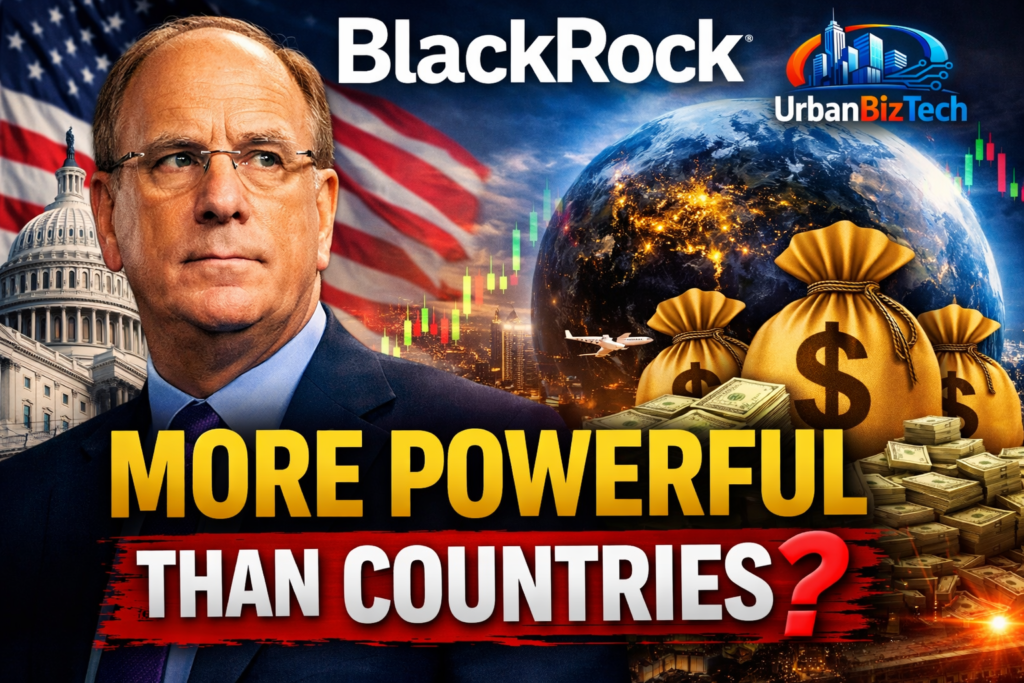
When people think about the world’s largest economic powers, they usually picture countries such as the United States or China. Yet over the past few decades, a different kind of giant has emerged — not a nation, but a financial institution.
BlackRock, founded in 1988, has grown into the largest asset manager on the planet. With more than $10 trillion in assets under management, its scale rivals the GDP of the world’s biggest economies.
Of course, these trillions are client assets, not money the company owns. But the size of the capital it oversees gives BlackRock extraordinary influence over markets, corporations, and even public policy.
How did this happen? And how powerful is BlackRock really?
The Scale: A Financial Universe Under One Roof
BlackRock’s assets under management fluctuate with markets, but they consistently remain around the $10+ trillion mark.
To put that into perspective, if those assets were compared to national economies, they would sit behind only the U.S. and China.
This staggering scale makes BlackRock:
- the largest asset manager in the world
- one of the biggest shareholders in thousands of public companies
- a central player in global capital flows
Size alone does not make a country — but it creates leverage, access, and influence.
How BlackRock Built Its Empire
1) Dominating ETFs Through iShares
BlackRock became the undisputed leader in exchange-traded funds after acquiring iShares. ETFs offer low costs, diversification, and simplicity, making them extremely attractive to both institutions and retail investors.
As passive investing exploded, so did BlackRock.
2) Institutional Relationships
The firm manages money for:
- pension funds
- sovereign wealth funds
- governments
- universities
- central banks
These relationships place BlackRock at the core of the global financial system.
3) Technology Advantage – Aladdin
Aladdin is one of the most important yet least understood pillars of BlackRock’s power.
It is a sophisticated risk-management and analytics platform used not only internally, but also licensed to many of the world’s largest financial institutions.
In other words, BlackRock helps others understand markets — while participating in them.
4) Ownership Across Corporate America
Together with Vanguard and State Street, BlackRock is often among the largest shareholders in major listed corporations.
Again, these stakes are held on behalf of clients.
But voting rights and governance influence still matter.
Why Some Say BlackRock Is an “Economic Power”
Influence Without Sovereignty
BlackRock does not make laws, print money, or run an army.
Yet it influences:
- capital allocation
- corporate governance
- sustainability standards
- long-term investment trends
Few private entities in history have had comparable reach.
Role During Crises
During the 2008 financial crisis and the COVID era, U.S. authorities hired BlackRock to help implement emergency asset-purchase programs.
Moments like these strengthened the perception that the firm operates close to the center of power.
Market Impact
When a manager of trillions adjusts strategies, markets feel it — from bonds to equities to real estate.
Criticism and Controversy
With scale comes suspicion.
Critics argue that concentrated ownership may:
- weaken competition
- create conflicts of interest
- give excessive influence to a small group of firms
Others worry about the “revolving door” between finance and government.
Supporters counter that BlackRock is largely a fiduciary, acting on behalf of millions of investors whose retirement savings depend on stable returns.
What Would Happen If BlackRock Failed?
This is one of the most fascinating questions.
Because the assets belong to clients, they would not simply vanish.
However, operational disruption at such a central institution could send shockwaves through global markets.
Its importance makes stability a priority not just for investors, but for regulators.
Larry Fink: The Architect
CEO Larry Fink helped build BlackRock with a focus on risk management, long-term thinking, and deep integration with institutions.
His annual letters to CEOs often shape conversations about capitalism and sustainability worldwide.
BlackRock is not a country, but it is undeniably a pillar of the global economic system.
Through scale, technology, and institutional trust, it has become one of the most influential financial actors of the modern era.
Love it or fear it — ignoring it is impossible.
FAQ
Is BlackRock richer than countries?
Not exactly. BlackRock manages assets for clients. It does not own this money the way a country produces GDP.
Why is BlackRock so powerful?
Because of its massive scale, shareholder voting power, technology platform Aladdin, and relationships with governments and institutions.
Who owns BlackRock?
Its shares are publicly traded and largely owned by institutional and retail investors.
Does BlackRock control companies?
It holds significant stakes on behalf of clients, which gives governance influence but not direct managerial control.
What is Aladdin?
A risk-management and investment analytics system used globally by major financial institutions.
Pingback: 👉 How Warren Buffett Built a $100+ Billion Fortune: The Investing Strategy That Made Him a Legend