
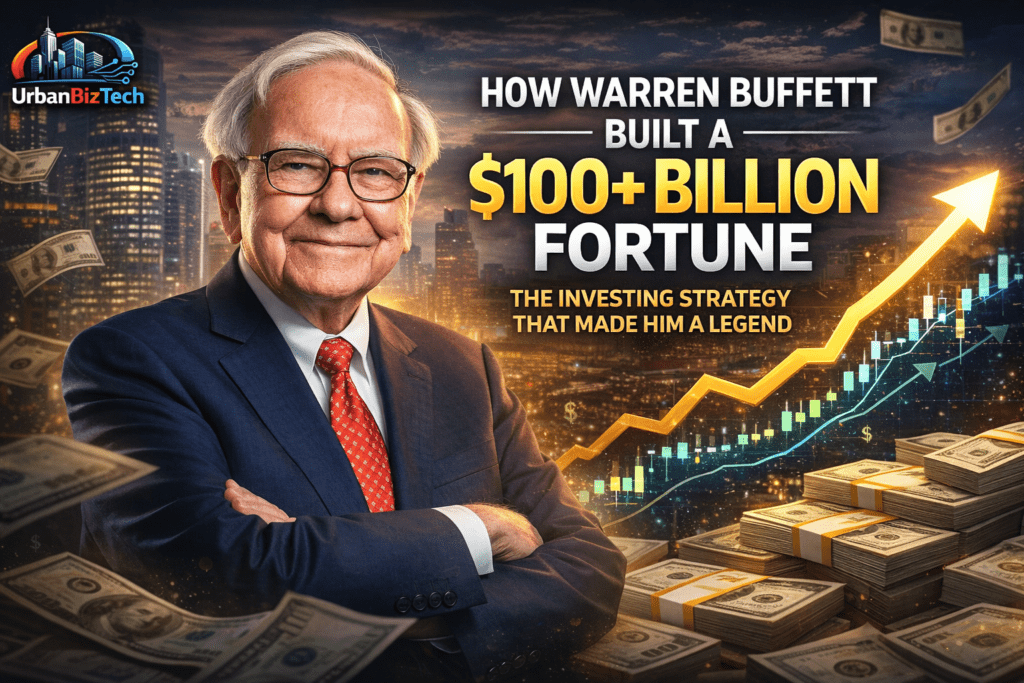
An 80-Year Journey of Financial Intelligence, Discipline, and Long-Term Vision
Early Beginnings: The Boy Who Saw the World Differently
Warren Edward Buffett was born on August 30, 1930, in Omaha, Nebraska. His father, Howard Buffett, worked as a stockbroker before becoming a U.S. congressman, and his mother, Leila, ran the household with strict discipline.
But what truly made Warren different wasn’t just his environment — it was how he understood money from an incredibly young age.
A child who read numbers like stories
While other kids played outside, Warren read books about business. At just seven years old, he discovered One Thousand Ways to Make $1,000, a book that changed his life.
He began asking unusual questions for a child:
- How can money work for me?
- How does investing create wealth?
- Why is time a powerful ally?
His first business experiments
Buffett didn’t wait for adulthood.
- He bought Coca-Cola in bulk and resold it.
- He sold chewing gum door to door.
- He collected lost golf balls and flipped them for profit.
- He delivered newspapers morning and evening.
At age 11, he bought his first stock — Cities Service — for $38.
It fell to $27. He waited. It rose to $40, and he sold, relieved.
Soon after, the stock climbed to $200.
The lesson hit him early:
patience beats panic.
The Young Man Who Wanted to Be a Millionaire by 30
Buffett wasn’t a typical student. He disliked abstract theory but loved math, statistics, and economics.
At 14, he filed his first tax return and even deducted $35 for his bicycle, which he used for newspaper delivery.
Rejected by Harvard — the best thing that happened
After studying at the University of Nebraska, Buffett applied to Harvard Business School.
He was rejected.
Instead, he enrolled at Columbia, where he met the man who would shape his future: Benjamin Graham, the father of value investing and author of The Intelligent Investor.
From Graham, Buffett learned:
- Markets are not always rational.
- Price is what you pay; value is what you get.
- Buy a dollar for fifty cents.
From Employee to Investor
Buffett desperately wanted to work for Graham. At first, he was turned down.
He returned to Omaha, worked as a broker, and waited.
Eventually, Graham called.
The training ground
During those years, Buffett mastered:
- Reading financial statements
- Evaluating intrinsic value
- Removing emotion from decisions
- Finding overlooked opportunities
Yet Buffett began evolving beyond Graham.
He realized great businesses were more than numbers — they had brands, leadership, and durable advantages.
Buffett Partnership: Where the Legend Began
In 1956, at just 25, Buffett launched Buffett Partnership Ltd. with $105,000 from friends and family.
His early strategy
He hunted for extremely undervalued companies and applied Graham’s philosophy with relentless discipline.
The results
Between 1956 and 1969, the partnership delivered nearly 29% annual returns, crushing the Dow.
Wall Street began to notice.
Berkshire Hathaway: The Company He Never Meant to Own
In 1962, Buffett started buying shares in a struggling textile firm called Berkshire Hathaway because it looked cheap.
After a dispute with management, he bought control.
He later called it one of his worst investments.
It became his greatest platform.
From textiles to an empire
Buffett shut down the failing mills and transformed Berkshire into a holding company for investments and acquisitions.
Building the Empire
Insurance: the magic engine
Buying insurers like GEICO gave Buffett access to the famous float — premiums collected before claims are paid.
That money could be invested.
Legendary holdings
Through Berkshire, Buffett accumulated major stakes in:
- Coca-Cola
- American Express
- Apple
- Bank of America
- Gillette
- The Washington Post
- Kraft Heinz
- BNSF Railway
- Duracell
Each decision relied on:
- Deep understanding
- Trust in management
- Long-term thinking
The Buffett Philosophy: Why He Wins
Value investing
Buy wonderful businesses at fair prices.
Patience
“The stock market is a device for transferring money from the impatient to the patient.”
Avoid unnecessary debt
Leverage can destroy even smart investors.
Stay within your circle of competence
If he doesn’t understand it, he doesn’t buy it.
Bet on people
Great managers multiply value.
From Millionaire to Billionaire
The power of compounding
Buffett credits most of his wealth to starting early and letting returns snowball.
Rarely selling
He holds investments for decades.
Reinvesting profits
Capital keeps working, year after year.
Berkshire’s stock rose from about $19 in the 1960s to hundreds of thousands of dollars per share.
The Human Side of Warren Buffett
Despite immense wealth:
- He still lives in the house he bought in 1958.
- He drives modest cars.
- He loves fast food and drinks Coca-Cola daily.
- He works from a simple office.
The Giving Pledge
Buffett promised to donate 99% of his fortune and, with Bill Gates, encouraged other billionaires to do the same.
Lessons from Buffett’s Life
- Start early — time is your greatest asset.
- Invest in yourself through reading and learning.
- Be fearful when others are greedy, greedy when others are fearful.
- Wealth requires patience.
- Simplicity often wins.
Why Buffett May Be the Greatest Investor Ever
His success wasn’t luck.
It was built on:
- Clear thinking
- Emotional discipline
- Long horizons
- Respect for value
- Ethical responsibility
Warren Buffett didn’t just build wealth.
He built a philosophy that continues to guide generations of investors.
Frequently Asked Questions (FAQ)
How did Warren Buffett become so rich?
Warren Buffett built his fortune through long-term value investing, buying strong companies at reasonable prices, and allowing compound interest to grow his wealth over decades.
What is Warren Buffett’s investment strategy?
His strategy focuses on understanding businesses deeply, investing within his circle of competence, trusting good management, and holding investments for the long run.
What was Warren Buffett’s first stock?
At age 11, Buffett bought shares of Cities Service. The experience taught him one of his most important lessons: patience is essential in investing.
What companies does Warren Buffett own?
Through Berkshire Hathaway, Buffett owns or holds major stakes in companies such as Apple, Coca-Cola, American Express, Bank of America, and many others.
Why is Berkshire Hathaway so expensive per share?
Buffett never split the stock and focused on long-term growth, which allowed compounding to push the share price to extremely high levels.
Does Warren Buffett trade frequently?
No. Buffett is famous for holding investments for years, sometimes decades.
What can beginners learn from Warren Buffett?
Start early, keep learning, avoid emotional decisions, think long term, and invest in businesses you truly understand.
How much of his money will Buffett donate?
He has pledged to give away about 99% of his wealt
Pingback: The Billionaire Mindset: How the Ultra-Wealthy Think, Decide, and Build Lasting Success - Urban Business Technology
Pingback: BlackRock: The Trillion-Dollar Giant Quietly Controlling Global Finance